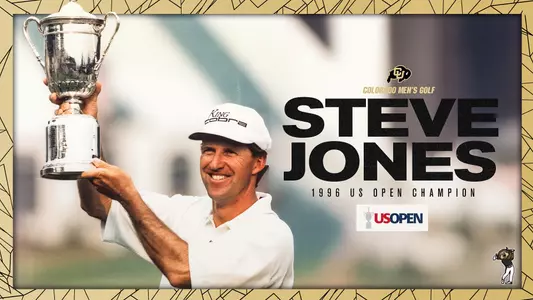
Photo by: Ashton Scott
Flashback 30 Years: Steve Jones Wins The U.S. Open
June 16, 2026 | General, Men's Golf, Alumni C Club
The CU graduate sizzled over the last three rounds
It's U.S. Open week, with this year's event being held at Shinnecock on Long Island. With that in mind, we thought we'd go down memory lane and revisit Steve Jones' win 30 years ago today in 1996, the fourth U.S. Open won by a Buffalo (Hale Irwin won the first three, in 1974, 1979 and 1990).
See the final round here: 1996 U.S. Open (Final Round): Steve Jones Gets the Win at Oakland Hills | Full Broadcast - YouTube
See the final round here: 1996 U.S. Open (Final Round): Steve Jones Gets the Win at Oakland Hills | Full Broadcast - YouTube
It's been 30 years since Father's Day on June 16, 1996, when University of Colorado alum Steve Jones won the U.S. Open in dramatic fashion. One thing for certain, his hometown of Yuma on the eastern Colorado plains hasn't forgotten.
The City of Yuma's City Council declared the week of June 7-13, "Steve Jones Week," recognizing the 30th anniversary of the former Buffs' win, the fourth U.S. Open by a CU golfer; Hale Irwin won the other three (1974, 1979 and 1990). The honor took the Jones family completely by total surprise.
"We had no idea this was happening and are truly humbled by it," said Steve's wife of 39 years, Bonnie. "Steve grew up in Yuma and those formative years there shaped him in so many ways. He's always spoken so fondly of his time there, the community, and the people who poured into him as a young athlete. We are deeply touched by the kindness of this gesture and so appreciative of this thoughtful honor and for the lasting impact Yuma had on our family."
Jones and Irwin (Boulder High) are the only two Buffaloes that attended both state high schools and then college to win a U.S. Open. Both are members of the Colorado Sports Hall of Fame and CU's Athletic Hall of Fame; Irwin has also been inducted into the World Golf Hall of Fame.
Though assorted injuries and an irregular heart rhythm cost him about a third of his professional career, the 67-year old Jones though essentially retired, is still allowed to play in up to four Champions events a year. He has played in one this season, tying for 60th in the Hoad Classic but had a respectable 1-under par 70-72-70—212 scorecard.
"Hopefully I'll play in a few more," Jones said. "It's just very hard to get this body in shape, too many little injuries so I can't practice as much. I'm not used to going out there and getting outdriven by 50 yards!"
Originally a story on CUBuffs.com in 2013, let's revisit his career from his CU days to an in-depth look at the '96 U.S. Open, held at Oakland Hills Country Club in Birmingham, Mich.
~~~~~~~~~~~~~~~~~~~~~~~~~~~~~~~~~~~~~~~~~~~~~~~~~~~~~~~~~~~~~~~~~~~~~~~~~~~~~~~~~~~~~~~
YUMA ROOTS
When did Jones realize himself that he could make a living playing the sport he loved?
"When I was 11, I had it in my heart that I wanted to be a professional golfer," he recalled. "It was snowing in Yuma, think it was January, and I remember watching golf on TV. The tournament was somewhere warm, I want to say Hawai'i, and I thought that is what I want to do.
"I started playing Yuma's nine hole course and I thought I wasn't bad, but I really didn't know. When I was 16 or 17, I was playing a round with Allen Miller (a PGA Tour player at the time who had been the nation's second-ranked amateur right around Jones' age) and he told me, 'You hit the ball far enough, you just need to hit it straighter.' That was a confidence boost."
He had played well in many Colorado Golf Association events, but was recruited mostly regionally.
THE PATH TO CU
His road to becoming a Buffalo was unique. Few people know that he initially committed to New Mexico State. Born in nearby Artesia, a little over 100 miles east of Las Cruces, his father knew the Aggies' athletic director and had plenty of other connections there. In fact, the family didn't move to Colorado until Jones was 11. NMSU offered him a full scholarship.
The late Mark Simpson, in his first year as Colorado head coach after replacing the legendary Les Fowler, targeted Jones as his first major recruit and set out to convince him to stay in state. But a full ride at CU was expensive, and most golf scholarships back in the day were awarded on a percentage basis, with hardly anyone getting all expenses covered.
Simpson had enough funds to offer him about a 75 percent scholarship for four years, but the money just wasn't there for Jones, one of seven children, to pay the balance. It looked like his desire to play college golf in the state where he first picked up a golf club was going to down the drain until Ron Rope, a donor to the golf team, stepped up and committed the other 25 percent of Jones' scholarship, and for all four years. Jones was a Buffalo.
HIS TIME IN BOULDER
In 1978 as a freshman in Boulder, early in the spring semester, it was discovered he had an Atrial fibrillation, commonly known as an irregular heart rhythm. He would undergo the first of 33 "electrical cardioversion" procedures to this day, which in layman's terms shocks the heart back into a more normal rhythm. He's had four Ablations, which has helped with his A-Fibs; the last was in March a year ago..
That initial episode turned out to be just a minor blip his first year at CU, and he missed just a few workouts and practices. He remained injury-free throughout his four-year Buff career, where he would average 73.75 strokes per round, still third on the school's all-time career list for players with 120 or more rounds; he played 141.
"My favorite memory at CU was my coach," Jones recalled. "At the time, I looked at Mark as the coach, but he became much more than that after college. That was really meaningful to me, we became better and better friends as the years went by. That's the quality of a good coach, they are your mentor and teacher first, and then the relationship changes where you become good friends."
"We had a great schedule, we flew everywhere, we played a lot of great schools," Jones said of his days as a Buff. "In the winter, we could hardly ever practice and our games weren't very good (at the start of spring season), but I really believe it kept us hungry. It kept me more involved in golf going forward; a lot of guys who played in the warmer states got burned out playing 12 months out of the year.
"In the wintertime, we were able to take a break from the game, work on our studies, and then get going again in late January. I think that was a big advantage for me, personally."
Simpson passed away at the age of 55 from complications due to lung cancer; Jones was one of the featured eulogists at his memorial service in December 2005. Up until the day he died, Jones learned a lot from Simpson that continued to draw from his entire career.
"Mark used to tell me, 'Look, you find a routine that works, and then you stick to it.' He was always really proud that you would stick to things, your game plan so-to-speak, and that you wouldn't give up.
"I remember in a tournament as sophomore, I was 8-over par going into the 18th hole in the last round," he continued. "Mark came over to watch me finish. Though I was going to end up somewhere in the middle of the pack, I still didn't want to shoot an 80 and had a determined look about me.
"He asked me what was going on and I told him, 'I'm not shooting an 80.' Mark said, 'That's a good goal. You're never quitting. Don't ever, ever quit. Keep trying.' It was simple, but my parents were the same way, always telling me to "do the best you can, but don't ever quit."
Jones birdied that hole and finished with a 77-78-79—234 scorecard in Texas' Morris Williams Intercollegiate.
He eventually earned first-team All-Big Eight Conference honors four times and second-team All-American honors as a senior in 1981. That was quite a year for him, as he also was low amateur in the Colorado Open (for the second time), won the state's match play tournament and earned the CGA's Player of the Year nod. With teammates Rick Cramer and Terry Kahl, the amateurs defeated the pros, 16-8, in the annual Colorado Cup matches.
In CU golf history, he is second in career top 10 finishes with 19, fourth in top 20 efforts with 26 (a mark he held for 18 years), and tied for fourth in top 5 finishes with 10. He was one of a very small number of Big Eight Conference players to finish in the top 10 in four league championships, and in his case, all in the top seven as he was third twice and seventh twice. He is one of 17 members of CU's prestigious "10,000 Stroke Club," with 10,399 (to make the club you have to play in most tournaments annually; he played in 47.
EARLY PROFESSIONAL CAREER
Jones made it to the finals in Tour Qualifying School in November 1981. After advancing out of the regionals, he visited his brother in Florida where the finals were scheduled. Just ahead of competing in the tournament of his life to that point, he suffered a broken thumb. How? He was playing with his 5-year old niece and she just happened to hit his thumb at just the right angle to cause a break.
He actually shrugged that off and finished seventh at Q School, earning is PGA Tour card. He played about half a dozen tournaments in 1982, earning around $2,700, but he could barely swing the club anymore without severe pain in the thumb. Off he went to Columbus, Ga., where the famous Dr. Jim Andrews performed surgery, which was a success; but he was out for the season.
The next four years, he was reasonably healthy, but because he had limited success on the Tour, he had to return to Q School in the fall of 1986 to earn his card again. He did so in grand style, winning what is often referred to as golf's "most grueling annual tournament."
VICTORY AT PEBBLE
He was 66th on the money list for 1987, playing in 30 events and setting the stage to reach another level of success as the decade was drawing to a close. He would win four times over the next two seasons, but his first was extra special, made so by a surprise in the gallery on Sunday at the 1988 Pebble Beach Pro-Am.
A second round 64 thrust Jones into the lead entering the weekend, and a 70 on Saturday gave him a six shot lead over Bob Tway and in position for victory. In the crowd on Sunday, his college coach, Mark Simpson.
Jones said, "What are you doing here? And Mark answered, 'I'm here to watch you win your first PGA Tournament.' And I said something clever like, 'Really?' I was excited, pumped."
It was a wild day: Tway actually caught Jones with a 68 – Jones shot 74 – and the two had to hold off a charging Greg Norman who ended up one shot behind. With Simpson there as a calming influence, Jones sank an 18-foot birdie putt on the second playoff hole and earned his first Tour win, along with a check for $126,000.
The lanky 6-foot-4 kid from Yuma, who took up golf when he was 11 playing the Yuma High Plains Recreation Association 9-hole course (since renamed Indian Hills Golf Course), had won on golf's biggest stage.
"I was one of the first 'High Plains Drifter golfers,'" Jones joked, referring to his first golf course's name and the Clint Eastwood movie.
His career then took off, with three wins in 1989 at the MONY Tournament of Champions, the Bob Hope Chrysler Classic and the Canadian Open. His rise had actually coincided with the success of CU's football team, so much so that he met Hope the same year as Colorado's three football All-Americans, Joe Garten, Tom Rouen and Alfred Williams.
isaster struck in November 1991. Jones had a passion for dirt bikes, and that month was in a horrific accident in which he suffered a broken ankle, a separated shoulder and ligament damage to his left ring finger, which turned out to be the worst of the injuries. He missed three full years on the Tour, not returning to action until 1995. Granted an exemption for those years for being injured, he played in 24 events and earned just under $235,000 in his return, placing 79th on the money list. He was allowed to keep his card, but had to qualify for the majors.
A WEEKEND TO REMEMBER
Sunday, always Father's Day, at the U.S. Open is annually one of the most exciting days in all of sports. And this one in 1996 didn't disappoint. Oakland Hills Country Club was a challenging 6,974-yard layout playing to a par-70, and being a USGA event, the second cut of the rough being the usual high and thick, if you unfortunately found it instead of the fairway.
Jones already had been battle tested just to qualify. He won the local qualifying in a playoff just to earn the right to advance to sectionals, where he won to make into the 156-man field, which, as a side note, included Tiger Woods playing as an amateur for the final time. During his hey days, he was one of the longest hitters on the Tour; but Oakland Hills had just two par-5's, limiting the long drivers to fewer eagle opportunities.
Payne Stewart and Woody Austin held the lead after first round with 3-under 67's; Jones was well down the line after a 74, mired in a tie for 82nd. But a second round 66 thrust him into the top five, two off the lead. It tied for the low score of the round, in which there were just 20 in the 60's (or subpar) in the 156-man field.
Tom Lehman held the third round lead at 2-under par after fashioning a tournament best 5-under 65, with Jones in second, one back after a 1-under 69; Davis Love was two off the pace and just three strokes down were the likes of Ernie Els, Jim Furyk and Colin Montgomerie. After seven holes, Lehman extended his lead to three over Jones, who would get one back by birdying 9; the pair, playing in the final twosome, then headed to the back nine.
The final stretch was a rollercoaster. Jones proceeded to score birdies on 10 and 12, holes Lehman bogeyed; Jones was now up by two with six to play. Meanwhile, Love had pulled even with Lehman, and after Jones bogeyed 13, Love's birdie on 15 tied him for the lead with Lehman one back with three holes remaining.
Jones and Love bogeyed 17, and on the 18th hole, you had Love on the green and Jones and Lehman on the tee, all tied at 2-under. The possibility of an 18-hole Monday playoff now loomed, though 18 played as the second toughest hole in the entire tournament and this Sunday, par was a good score for the day.
Love had a 20-foot putt for birdie that lagged to within three feet, but he missed and made bogey, and it was back to a two man duel. Lehman's drive on 18 landed in a bunker; he eventually missed a 15-footer for par. Jones hit his second shot to within 12 feet, and two putted for the win (the second from about 22 inches), thus claiming his first and only major and also becoming the first sectional qualifier to win the Open in 20 years.
The win wasn't a fluke; there were just 51 rounds under par in the entire Open, and Jones was the only player with three – just four others managed two. His average drive went 279 yards, he hit 50 greens in regulation and hit 41 fairways, all top 10 numbers for the week on his way to cashing a $425,000 check (this year's winner will make $4.3 million – around 11th place will earn what Jones did!).
"One thing I remember from that whole week was I had just read the (Ben) Hogan book, and what I got from that book was one shot at a time," Jones said. "That's what I needed, to play golf one shot at a time. Your next shot is the most important shot you'll ever hit. You need to concentrate on what is in the moment, it doesn't matter what you just did. It sounds easy, but it is hard to do. All the best players do it."
He would win the Comeback Player of the Year honor, named for Ben Hogan, for 1996.
POST OAKLAND HILLS
He won twice more in 1997, in his now hometown Phoenix Open (where he shot his career low round of 62) and the Bell Canadian Open – he won for the last of eight times overall on the PGA Tour in 1998 (Quad Cities Open) and overall enjoyed a successful career. He earned over $6.5 million after making the cut in 279 tournaments, which included 116 top 25 finishes and 44 in the top 10. His top finish on the money list was eighth in1989, becoming the sport's 99th millionaire that year (now not even the top payoff is almost all events).
His U.S. Open win was his only triumph in a "major," though he played in 12 overall, The Masters nine times (best was a tie for 20th in 1990), seven British Opens (31st in 2000 topped his effort there) and in eight PGA Championships (tie for 9th in 1988 his best there).
Golfers naturally wind down a bit on the PGA Tour as they enter their 40's, but look to the Champions Tour to ratchet things up again when they become eligible for it when they turn 50. It was no different for Jones, except …
He developed "tennis" elbow, enduring the limitations it caused his right arm in 2002, and underwent surgery for it in 2003; he would miss the next three seasons, returning to the Tour in 2005 at age 47. He played in 20 events that year, 27 tournaments in 2006 and played in nine events on the front end of 2007, but had developed the same injury in his left elbow. He had surgery that summer, followed by another shoulder surgery in 2008, and then a left rotator cuff operation in 2009, when he had planned to make his debut on the Champions Tour. But that had to wait two more years. And by the way, he had surgery in 2003 that cauterized parts of the heart muscle that cause
erratic electrical signals.
"The irony is I've had all these issues with elbows, shoulders, fingers, thumbs and ankles, but I've never missed any golf because of my heart," Jones said.
THE "OLD GUYS" TOUR
Jones finally made his debut on the senior circuit in 2011, but did not have his card and relied on sponsor exemptions for the most part. He teed off in 10 events, making the cut in all, but was down the list in earnings with just over $123,000. He made 11 of 12 cuts the next year, but wasn't high enough on the money list to earn his full-time card. Back to qualifying school, which forced him to miss his induction into CU's Athletic Hall of Fame.
"I really wanted to get back to Boulder, especially looking at who went into the Hall in that class," Jones said at the time. "All-Americans, Olympians, our Heisman winner. But I've basically been hurt for over 10 years, or a third of my professional career. This is my living, I had to be in Florida."
Jones shot 4-under for four rounds, tied for 11th and earned conditional Champions Tour status for 2013, meaning in the end he was likely eligible for most tournaments. He would eventually make the cut in 116 of 124 tournaments over the years, adding over $1.25 million to his earnings.
REMEMBERING CU
"Steve epitomizes what it means to be a Buffalo," current CU head coach Roy Edwards said. "Colorado kid. A great player while here and went on to have a tremendous professional career. Steve has given generously to the golf program throughout his adult life, not just financially, but with his time and general positive support.
"He has always been a guy who has asked, 'What can I do to help?' and is clearly grateful for the opportunities CU afforded him. He has been a special asset to the University of Colorado since that day he decided to be a Buff."
The City of Yuma's City Council declared the week of June 7-13, "Steve Jones Week," recognizing the 30th anniversary of the former Buffs' win, the fourth U.S. Open by a CU golfer; Hale Irwin won the other three (1974, 1979 and 1990). The honor took the Jones family completely by total surprise.
"We had no idea this was happening and are truly humbled by it," said Steve's wife of 39 years, Bonnie. "Steve grew up in Yuma and those formative years there shaped him in so many ways. He's always spoken so fondly of his time there, the community, and the people who poured into him as a young athlete. We are deeply touched by the kindness of this gesture and so appreciative of this thoughtful honor and for the lasting impact Yuma had on our family."
Jones and Irwin (Boulder High) are the only two Buffaloes that attended both state high schools and then college to win a U.S. Open. Both are members of the Colorado Sports Hall of Fame and CU's Athletic Hall of Fame; Irwin has also been inducted into the World Golf Hall of Fame.
Though assorted injuries and an irregular heart rhythm cost him about a third of his professional career, the 67-year old Jones though essentially retired, is still allowed to play in up to four Champions events a year. He has played in one this season, tying for 60th in the Hoad Classic but had a respectable 1-under par 70-72-70—212 scorecard.
"Hopefully I'll play in a few more," Jones said. "It's just very hard to get this body in shape, too many little injuries so I can't practice as much. I'm not used to going out there and getting outdriven by 50 yards!"
Originally a story on CUBuffs.com in 2013, let's revisit his career from his CU days to an in-depth look at the '96 U.S. Open, held at Oakland Hills Country Club in Birmingham, Mich.
~~~~~~~~~~~~~~~~~~~~~~~~~~~~~~~~~~~~~~~~~~~~~~~~~~~~~~~~~~~~~~~~~~~~~~~~~~~~~~~~~~~~~~~
YUMA ROOTS
When did Jones realize himself that he could make a living playing the sport he loved?
"When I was 11, I had it in my heart that I wanted to be a professional golfer," he recalled. "It was snowing in Yuma, think it was January, and I remember watching golf on TV. The tournament was somewhere warm, I want to say Hawai'i, and I thought that is what I want to do.
"I started playing Yuma's nine hole course and I thought I wasn't bad, but I really didn't know. When I was 16 or 17, I was playing a round with Allen Miller (a PGA Tour player at the time who had been the nation's second-ranked amateur right around Jones' age) and he told me, 'You hit the ball far enough, you just need to hit it straighter.' That was a confidence boost."
He had played well in many Colorado Golf Association events, but was recruited mostly regionally.
THE PATH TO CU
His road to becoming a Buffalo was unique. Few people know that he initially committed to New Mexico State. Born in nearby Artesia, a little over 100 miles east of Las Cruces, his father knew the Aggies' athletic director and had plenty of other connections there. In fact, the family didn't move to Colorado until Jones was 11. NMSU offered him a full scholarship.
The late Mark Simpson, in his first year as Colorado head coach after replacing the legendary Les Fowler, targeted Jones as his first major recruit and set out to convince him to stay in state. But a full ride at CU was expensive, and most golf scholarships back in the day were awarded on a percentage basis, with hardly anyone getting all expenses covered.
Simpson had enough funds to offer him about a 75 percent scholarship for four years, but the money just wasn't there for Jones, one of seven children, to pay the balance. It looked like his desire to play college golf in the state where he first picked up a golf club was going to down the drain until Ron Rope, a donor to the golf team, stepped up and committed the other 25 percent of Jones' scholarship, and for all four years. Jones was a Buffalo.
HIS TIME IN BOULDER
In 1978 as a freshman in Boulder, early in the spring semester, it was discovered he had an Atrial fibrillation, commonly known as an irregular heart rhythm. He would undergo the first of 33 "electrical cardioversion" procedures to this day, which in layman's terms shocks the heart back into a more normal rhythm. He's had four Ablations, which has helped with his A-Fibs; the last was in March a year ago..
That initial episode turned out to be just a minor blip his first year at CU, and he missed just a few workouts and practices. He remained injury-free throughout his four-year Buff career, where he would average 73.75 strokes per round, still third on the school's all-time career list for players with 120 or more rounds; he played 141.
"My favorite memory at CU was my coach," Jones recalled. "At the time, I looked at Mark as the coach, but he became much more than that after college. That was really meaningful to me, we became better and better friends as the years went by. That's the quality of a good coach, they are your mentor and teacher first, and then the relationship changes where you become good friends."
"We had a great schedule, we flew everywhere, we played a lot of great schools," Jones said of his days as a Buff. "In the winter, we could hardly ever practice and our games weren't very good (at the start of spring season), but I really believe it kept us hungry. It kept me more involved in golf going forward; a lot of guys who played in the warmer states got burned out playing 12 months out of the year.
"In the wintertime, we were able to take a break from the game, work on our studies, and then get going again in late January. I think that was a big advantage for me, personally."
Simpson passed away at the age of 55 from complications due to lung cancer; Jones was one of the featured eulogists at his memorial service in December 2005. Up until the day he died, Jones learned a lot from Simpson that continued to draw from his entire career.
"Mark used to tell me, 'Look, you find a routine that works, and then you stick to it.' He was always really proud that you would stick to things, your game plan so-to-speak, and that you wouldn't give up.
"I remember in a tournament as sophomore, I was 8-over par going into the 18th hole in the last round," he continued. "Mark came over to watch me finish. Though I was going to end up somewhere in the middle of the pack, I still didn't want to shoot an 80 and had a determined look about me.
"He asked me what was going on and I told him, 'I'm not shooting an 80.' Mark said, 'That's a good goal. You're never quitting. Don't ever, ever quit. Keep trying.' It was simple, but my parents were the same way, always telling me to "do the best you can, but don't ever quit."
Jones birdied that hole and finished with a 77-78-79—234 scorecard in Texas' Morris Williams Intercollegiate.
He eventually earned first-team All-Big Eight Conference honors four times and second-team All-American honors as a senior in 1981. That was quite a year for him, as he also was low amateur in the Colorado Open (for the second time), won the state's match play tournament and earned the CGA's Player of the Year nod. With teammates Rick Cramer and Terry Kahl, the amateurs defeated the pros, 16-8, in the annual Colorado Cup matches.
In CU golf history, he is second in career top 10 finishes with 19, fourth in top 20 efforts with 26 (a mark he held for 18 years), and tied for fourth in top 5 finishes with 10. He was one of a very small number of Big Eight Conference players to finish in the top 10 in four league championships, and in his case, all in the top seven as he was third twice and seventh twice. He is one of 17 members of CU's prestigious "10,000 Stroke Club," with 10,399 (to make the club you have to play in most tournaments annually; he played in 47.
EARLY PROFESSIONAL CAREER
Jones made it to the finals in Tour Qualifying School in November 1981. After advancing out of the regionals, he visited his brother in Florida where the finals were scheduled. Just ahead of competing in the tournament of his life to that point, he suffered a broken thumb. How? He was playing with his 5-year old niece and she just happened to hit his thumb at just the right angle to cause a break.
He actually shrugged that off and finished seventh at Q School, earning is PGA Tour card. He played about half a dozen tournaments in 1982, earning around $2,700, but he could barely swing the club anymore without severe pain in the thumb. Off he went to Columbus, Ga., where the famous Dr. Jim Andrews performed surgery, which was a success; but he was out for the season.
The next four years, he was reasonably healthy, but because he had limited success on the Tour, he had to return to Q School in the fall of 1986 to earn his card again. He did so in grand style, winning what is often referred to as golf's "most grueling annual tournament."
VICTORY AT PEBBLE
He was 66th on the money list for 1987, playing in 30 events and setting the stage to reach another level of success as the decade was drawing to a close. He would win four times over the next two seasons, but his first was extra special, made so by a surprise in the gallery on Sunday at the 1988 Pebble Beach Pro-Am.
A second round 64 thrust Jones into the lead entering the weekend, and a 70 on Saturday gave him a six shot lead over Bob Tway and in position for victory. In the crowd on Sunday, his college coach, Mark Simpson.
Jones said, "What are you doing here? And Mark answered, 'I'm here to watch you win your first PGA Tournament.' And I said something clever like, 'Really?' I was excited, pumped."
It was a wild day: Tway actually caught Jones with a 68 – Jones shot 74 – and the two had to hold off a charging Greg Norman who ended up one shot behind. With Simpson there as a calming influence, Jones sank an 18-foot birdie putt on the second playoff hole and earned his first Tour win, along with a check for $126,000.
The lanky 6-foot-4 kid from Yuma, who took up golf when he was 11 playing the Yuma High Plains Recreation Association 9-hole course (since renamed Indian Hills Golf Course), had won on golf's biggest stage.
"I was one of the first 'High Plains Drifter golfers,'" Jones joked, referring to his first golf course's name and the Clint Eastwood movie.
His career then took off, with three wins in 1989 at the MONY Tournament of Champions, the Bob Hope Chrysler Classic and the Canadian Open. His rise had actually coincided with the success of CU's football team, so much so that he met Hope the same year as Colorado's three football All-Americans, Joe Garten, Tom Rouen and Alfred Williams.
isaster struck in November 1991. Jones had a passion for dirt bikes, and that month was in a horrific accident in which he suffered a broken ankle, a separated shoulder and ligament damage to his left ring finger, which turned out to be the worst of the injuries. He missed three full years on the Tour, not returning to action until 1995. Granted an exemption for those years for being injured, he played in 24 events and earned just under $235,000 in his return, placing 79th on the money list. He was allowed to keep his card, but had to qualify for the majors.
A WEEKEND TO REMEMBER
Sunday, always Father's Day, at the U.S. Open is annually one of the most exciting days in all of sports. And this one in 1996 didn't disappoint. Oakland Hills Country Club was a challenging 6,974-yard layout playing to a par-70, and being a USGA event, the second cut of the rough being the usual high and thick, if you unfortunately found it instead of the fairway.
Jones already had been battle tested just to qualify. He won the local qualifying in a playoff just to earn the right to advance to sectionals, where he won to make into the 156-man field, which, as a side note, included Tiger Woods playing as an amateur for the final time. During his hey days, he was one of the longest hitters on the Tour; but Oakland Hills had just two par-5's, limiting the long drivers to fewer eagle opportunities.
Payne Stewart and Woody Austin held the lead after first round with 3-under 67's; Jones was well down the line after a 74, mired in a tie for 82nd. But a second round 66 thrust him into the top five, two off the lead. It tied for the low score of the round, in which there were just 20 in the 60's (or subpar) in the 156-man field.
Tom Lehman held the third round lead at 2-under par after fashioning a tournament best 5-under 65, with Jones in second, one back after a 1-under 69; Davis Love was two off the pace and just three strokes down were the likes of Ernie Els, Jim Furyk and Colin Montgomerie. After seven holes, Lehman extended his lead to three over Jones, who would get one back by birdying 9; the pair, playing in the final twosome, then headed to the back nine.
The final stretch was a rollercoaster. Jones proceeded to score birdies on 10 and 12, holes Lehman bogeyed; Jones was now up by two with six to play. Meanwhile, Love had pulled even with Lehman, and after Jones bogeyed 13, Love's birdie on 15 tied him for the lead with Lehman one back with three holes remaining.
Jones and Love bogeyed 17, and on the 18th hole, you had Love on the green and Jones and Lehman on the tee, all tied at 2-under. The possibility of an 18-hole Monday playoff now loomed, though 18 played as the second toughest hole in the entire tournament and this Sunday, par was a good score for the day.
Love had a 20-foot putt for birdie that lagged to within three feet, but he missed and made bogey, and it was back to a two man duel. Lehman's drive on 18 landed in a bunker; he eventually missed a 15-footer for par. Jones hit his second shot to within 12 feet, and two putted for the win (the second from about 22 inches), thus claiming his first and only major and also becoming the first sectional qualifier to win the Open in 20 years.
The win wasn't a fluke; there were just 51 rounds under par in the entire Open, and Jones was the only player with three – just four others managed two. His average drive went 279 yards, he hit 50 greens in regulation and hit 41 fairways, all top 10 numbers for the week on his way to cashing a $425,000 check (this year's winner will make $4.3 million – around 11th place will earn what Jones did!).
"One thing I remember from that whole week was I had just read the (Ben) Hogan book, and what I got from that book was one shot at a time," Jones said. "That's what I needed, to play golf one shot at a time. Your next shot is the most important shot you'll ever hit. You need to concentrate on what is in the moment, it doesn't matter what you just did. It sounds easy, but it is hard to do. All the best players do it."
He would win the Comeback Player of the Year honor, named for Ben Hogan, for 1996.
POST OAKLAND HILLS
He won twice more in 1997, in his now hometown Phoenix Open (where he shot his career low round of 62) and the Bell Canadian Open – he won for the last of eight times overall on the PGA Tour in 1998 (Quad Cities Open) and overall enjoyed a successful career. He earned over $6.5 million after making the cut in 279 tournaments, which included 116 top 25 finishes and 44 in the top 10. His top finish on the money list was eighth in1989, becoming the sport's 99th millionaire that year (now not even the top payoff is almost all events).
His U.S. Open win was his only triumph in a "major," though he played in 12 overall, The Masters nine times (best was a tie for 20th in 1990), seven British Opens (31st in 2000 topped his effort there) and in eight PGA Championships (tie for 9th in 1988 his best there).
Golfers naturally wind down a bit on the PGA Tour as they enter their 40's, but look to the Champions Tour to ratchet things up again when they become eligible for it when they turn 50. It was no different for Jones, except …
He developed "tennis" elbow, enduring the limitations it caused his right arm in 2002, and underwent surgery for it in 2003; he would miss the next three seasons, returning to the Tour in 2005 at age 47. He played in 20 events that year, 27 tournaments in 2006 and played in nine events on the front end of 2007, but had developed the same injury in his left elbow. He had surgery that summer, followed by another shoulder surgery in 2008, and then a left rotator cuff operation in 2009, when he had planned to make his debut on the Champions Tour. But that had to wait two more years. And by the way, he had surgery in 2003 that cauterized parts of the heart muscle that cause
erratic electrical signals.
"The irony is I've had all these issues with elbows, shoulders, fingers, thumbs and ankles, but I've never missed any golf because of my heart," Jones said.
THE "OLD GUYS" TOUR
Jones finally made his debut on the senior circuit in 2011, but did not have his card and relied on sponsor exemptions for the most part. He teed off in 10 events, making the cut in all, but was down the list in earnings with just over $123,000. He made 11 of 12 cuts the next year, but wasn't high enough on the money list to earn his full-time card. Back to qualifying school, which forced him to miss his induction into CU's Athletic Hall of Fame.
"I really wanted to get back to Boulder, especially looking at who went into the Hall in that class," Jones said at the time. "All-Americans, Olympians, our Heisman winner. But I've basically been hurt for over 10 years, or a third of my professional career. This is my living, I had to be in Florida."
Jones shot 4-under for four rounds, tied for 11th and earned conditional Champions Tour status for 2013, meaning in the end he was likely eligible for most tournaments. He would eventually make the cut in 116 of 124 tournaments over the years, adding over $1.25 million to his earnings.
REMEMBERING CU
"Steve epitomizes what it means to be a Buffalo," current CU head coach Roy Edwards said. "Colorado kid. A great player while here and went on to have a tremendous professional career. Steve has given generously to the golf program throughout his adult life, not just financially, but with his time and general positive support.
"He has always been a guy who has asked, 'What can I do to help?' and is clearly grateful for the opportunities CU afforded him. He has been a special asset to the University of Colorado since that day he decided to be a Buff."

Friday, September 18
Thursday, September 17
Thursday, September 17
Thursday, September 17