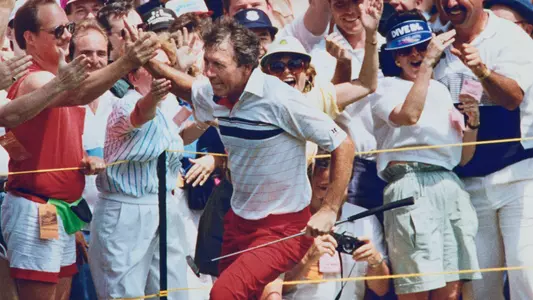
Irwin on his celebratory run around the 18th green in the 1990 U.S. Open
A Trip Down Memory Lane With Hale Irwin
June 26, 2026 | Men's Golf, Alumni C Club
CU alum remains one of six to win at least three U.S. Opens
World Golf Hall of Famer and CU alum Hale Irwin recently joined the Colorado Sports Hall of Fame podcast in what literally was a version of the old TV show, "This is Your Life." Excerpts from the podcast are included below; you can listen to the entire interview about 10 minutes into the podcast at https://youtu.be/4uwI__ybbV4.
BOULDER – The University of Colorado has its fair share of famous graduates in its 150 years, Supreme Court Justice Byron White perhaps forever topping the list.
Several actors have passed through – Robert Redford, Christopher Meloni (Law & Order SVU), Joan Van Ark (Dallas/Knots Landing), Larry Linville (M*A*S*H), Jonah Hill (Moneyball), Angus T. Jones (Two and a Half Men). Astronauts – 18 in all – have included Scott Carpenter (the second man to orbit the Earth), Jack Swigert (Apollo 13), Stuart Roosa (Apollo 14) and two who passed in space shuttle disasters, Ellison Onizuka (Challenger) and Kalpana Chawla (Columbia).
Then there is a New York Met opera singer, Keith Miller … the South Park tandem of Trey Parker and Matt Stone … and even two heads of state: Mongolian president Tsakhiagiin Elbegdorj and Liberian president Ellen Johnson Sirleaf. And let's not forget 120 Olympians, like medal winners Bill Toomey, Billy Kidd, Jimmie Heuga, Jenny Simpson and Emma Coburn.
As many say, athletics is the front porch to most universities. White, Swigert and Miller all lettered in football (White four sports in all). But if you look at the CU Alumni Wikipedia page, it lists more athletes than in any other category – 101 – not including those in sports journalism like Chris Fowler and Jim Gray. In the middle of that long list is Hale Irwin, winner of 65 PGA/Champions golf tournaments in his professional career, but after White, he may very well be the second-most successful graduate who wore the black and gold of the Buffaloes, if not overall (though Meloni is believed to have made $500,000 per episode!).
HALE'S EARLY YEARS
Born in Joplin, Mo., Irwin took up golf at the age of 4 and soon started dreaming of winning the U.S. Open. The family moved to Boulder from Baxter Springs, Kan., when he was 14. Shortly thereafter, his parents entered him in a local event that he won. He then played in the State Jaycee Junior Golf Tournament, where he finished third behind two other future Buffs, 10 back of Gary Polumbus and two behind John Hamer. All three qualified for the national tournament, where Polumbus and Hamer made the 36-hole cut; Irwin missed it, though remembered his scores some 67 years later.
"I finished third in the state, so next thing I know, we're off to Portsmouth, Virginia to play in a national tournament," he recalled. "Something I had never done in my life and I thought about it and immediately went to a club there, a very nice place called Elizabeth Manor Country Club. The first round I shot 79 and the next round I shot 90. Obviously I missed the cut, but I I learned so much. It was such a whirlwind of activity and opening my eyes to what's out there. That was probably the real seed that got planted my enthusiasm for golf."
He beat Tad Polumbus, another future CU duffer, the next year and made the Class B finals in the national meet. In 1961, he was third in the state and made nationals for a third straight year, where he finished 13th.
He would then star in football and golf at Boulder High School, which was a "farm system" for CU, especially the brothers Irwin (Hale and Phil) and Anderson (Dick and Bobby). By the time Hale was a senior, he had started to build an impressive resume in amateur play around the state. He already had state Jaycee, medal and match play titles to his credit when led BHS to the '63 state title, setting a record with a 6-under 210 total (and leading Boulder to set the team low score mark with help from Dick Anderson, who finished sixth).
His pre-CU career was topped by a 15-shot victory in the 1963 Colorado State Medal Play (now the Colorado Amateur). He defeated Hamer in the event held at Boulder Country Club with an impressive 63-68-66-66—263 scorecard. That was 21-under par. He also beat Les Fowler, his future coach at CU, by 22 shots. His last event before enrolling at CU was a third place finish in the prestigious Pikes Peak Invitational, where a recent CU grad, Gary Polumbus, beat him by three strokes.
"It was probably the real origin of my initial success," he said. "We moved out here from a small town in the extreme corner of southeast Kansas. When we moved out to Boulder when I was 14, baseball was a big sport then. I immediately got on a team and I enjoyed playing baseball, but just something I had to give up as I got older. I was driving a car now. I had a social life. I guess that meant a girlfriend. I was playing baseball. I was trying to play golf some. I was working eight hours a day. Something just had to give. So, baseball disappeared."
Two of the most influential people outside of his parents in his life were Fowler and teammate Larry McAtee, who just passed away on June 9. In reviewing newspaper articles of the day, it was pretty apparent that both led a revolution for younger players in state, snatching seven titles away from the old guard over a span of four years.
"Larry was one of those guys driven to succeed and won four state stroke play tournaments, was a friend and teammate and we traveled together to play in a couple tournaments," he said. "And Les Fowler who was a very good amateur player in the state of Colorado, he was the golf team administrator. He did not really coach. He was a very busy man, he had a business, he was a state legislator, but one of the nicest guys. If we went and played in an away match, Les would give me the golf balls to give to the guys and we'd go off on our own to the tournaments. It was a little different then. I owe a lot to Les Fowler and God bless him. He was a a very nice man to me."
He would win the medal event the next two summers and added the state's match play title to his trophy case in 1966.
FINDING HIS WAY TO CU
Boulder High School – originally State Prep School that matriculated its graduates to CU earlier in the century – was a hop, skip and a jump from campus.
When asked if he considered any other place for college, Irwin mused, "No not really. If I'm going to play football and get myself run over and torn apart, I'd stay in Boulder instead of somewhere else. I'd have a shoulder to cry on then. But I felt like CU was the place for me to play ball.
"Just a quick snapshot of how golf started, but did I want to play golf in college? Sure," he said. "I got kind of beat up and rolled on and kicked around as a sophomore and hurt my shoulder, missed the last two games of the football season, I thought, well, maybe golf is where I should go. But with some serious thought, my dad had always said, 'Don't start something you can't finish.'"
He actually was never recruited by any other college to play golf and had the full football scholarship at CU. Had he given up football, he'd have to give up the scholarship.
"And while I did enjoy football, there was no one, no one school, no one golf coach or anybody out there calling me or looking me up or sending me letters to say, 'How would you like to come and play golf?' I enjoyed being close to my family, my friends. There are a lot of things that didn't kind of come together – with all that in mind, I decided to stick it out and finish something that I had started."
ONE OF CU'S LAST TWO-WAY STARS
Irwin's sophomore year at CU – 1964 – was the last of the platoon era. Very few have played significantly on both sides of the ball since, though a certain Buffalo comes to mind, with Travis Hunter winning the 2024 Heisman Trophy playing 1,460 snaps between receiver and defensive back.
The 5-foot-11, 180-pound Irwin had played both quarterback and safety on CU's '63 freshman football team. He was no slouch in football: he was a two-time All-Big Eight cornerback and member of CU's All-Century Football Team (1890-1989). He also earned Academic All-American honors. He was behind Bernie McCall at quarterback most of his sophomore season but managed to rush for 100 yards and a touchdown (a 1-yard run at Oklahoma State). He was in on 112 tackles and had eight interceptions his last two years.
CU had gone 2-8 in both his freshman and sophomore seasons, slowly recovering from NCAA probation that stripped the program of many of its best players after the Buffaloes had won the '61 Big Eight championship. But signs were evident that the team was improving, especially the defense which went from allowing 245 points in 1963 to 156 in 1964 (and from two one-score losses to five).
"I enjoyed football. I enjoyed the sport," he said. "I enjoyed being with the other young men that were aspiring to put CU on the map even more than it already was."
How did it come about that after the platoon era, he wound up on the defensive side of the ball?
"Well, I didn't select it. Coach Crowder did for me," he recalled. "That was fine. And I just felt like my natural instincts were better on defense. My offensive prowess, while I think it was okay, just looking at it from self-analysis, I was better suited, better instinctively playing defense. And I think that's probably what Coach Crowder saw. Just playing with some of the best players you could possibly have, Sam Harris, an all-American who went on to play for the (New Orleans) Saints, and of course, Dick Anderson, all-pro with the Miami Dolphins."
The Buffs rebounded to go 6-2-2 and 7-3 in his final two seasons, with Irwin starring on a defense that allowed just 11.9 points per game over those 20 contests. Colorado finished third and then second in the Big Eight, laying the groundwork for over a decade of success to follow.
"The next football year was a banner year, much better for me. I no longer was a quarterback and you have people running after you. I was now the weak-side safety and running after people. The job description was a little different as far as football goes, but my golf kept inching itself toward a better measure of success."
Irwin's top game in that banner junior season came when he had two interceptions deep in Oklahoma territory – both in the fourth quarter – that helped preserve CU's 13-0 win in Norman. He also had two picks in the '67 opener loss to Miami-Florida, and the following week he picked one off in the final minute at the Baylor 22-yardline to safeguard CU's 13-7 verdict in Waco.
He just missed playing with his younger brother Phil, a linebacker who was the first active Buff in any sport to make the cover of Sports Illustrated (after CU ended Penn State's 34-game unbeaten streak in 1970). Phil was in the '67 recruiting class, enrolling at CU three months after Hale graduated with a bachelor's degree in marketing.
GOLF TO THE FOREFRONT
Commitment to football kept him from playing fall college golf events, though were much rarer at the time than they are now; dual matches were the bulk of competitions. But in the 11 spring tournaments CU played in, Irwin led the Buffaloes in 10 with three wins, and eight top five and 10 top 10 finishes. One of the wins came in the '66 Big Eight Championship, in which he would repeat as co-champion as a senior, tying for medalist honors with Oklahoma State's Grier Jones in the rain-shortened event to 36 holes. But in the process, he became of just eight players to win it twice in the 90-year history of the Big Eight Conference (joined later by CU's Bobby Kalinowski in 1993 and 1994).
He tied for 10th in the NCAA Championship that junior year, falling out of contention with a third round 77 after owning a two-stroke lead through 36 holes with a 70-71—141 showing. Chances would be he learned from that.
Prior to his senior year, he qualified for and made the cut in the U.S. Open, tying for 61st with a 23-over par 303 score on San Francisco's challenging Olympic Club course; but he was the second low amateur, 12 back of Johnny Miller.
The Colorado PGA named him the state's Amateur of the Year for 1966, while the Colorado Sports Hall of Fame honored him as the state's top college athlete for his achievements in both sports.
Soon followed the start of a tremendous senior season. He opened play with a win in the New Mexico State Intercollegiate, followed by a third place performance in the Houston All-American, one of golf's major events at the time. He was one of a handful of amateurs who played in a PGA Tour event – the Champions International – also in Houston but missed the cut. Then came the tie for Big Eight individual title, with several medalist honors interspersed throughout in dual matches.
But the big prize was ahead.
THE ULTIMATE COLLEGE VICTORY
Colorado never qualified as a team for the NCAA's in Irwin's three seasons, but by virtue of his conference wins, he earned individual invitations. Would he learn from his '66 performance in the NCAA's? You bet.
He was essentially in a battle with Florida's Steve Melnyk on the Shawnee Golf Course in Shawnee-on-Delaware, Pa. He was tied for second after an opening round of 2-under 70, and tied for third after a par effort, two back of Melnyk. Then came the round of his lifetime – at the time.
In the third round, he made nine birdies that measured only 94 feet in total length and an eagle -- a hole-in-one on the 220-yard par-3 14th enroute to an NCAA record 65. That was 7-under par on a 7,025-yard course with an ace at 335 feet in elevation with mid-1960s equipment. He had just 23 putts (eight one-putts) and hit 13 greens.
Now he held a five-shot edge over Melnyk, who shot par in round three, a seven-shot lead over Houston's Hal Underwood and nine-plus over the rest of the field..
"Let me put it this way. That round was the most bizarre round I've ever played in my life," he recalled with light laughter. "There were nine birdies and an eagle, so that was 11-under par, but with four bogeys, I only had four pars. I ran the gamut." The course was tweaked in places each round, the 14th hole reduced from 220 to around 180 yards, Irwin's club of choice for that distance being a 5-iron.
Going into the final round, he told the media present, "You know, I think Arnold Palmer is the greatest offensive player in golf. He doesn't concede a thing when he makes one of his charges. He doesn't know how to play differently. I admire Palmer and pattern my offensive style after his. I really didn't approach it this way a year ago."
His final round 79 wasn't as bad as it first appears – the average score for the field was a shade under 76. In the end, he finished with a 2-under 286 and a two-stroke victory over three players, including Big Eight rival Ross Randall of Kansas (who would go on to coach current CU head coach Roy Edwards in college at KU).
"I do remember the course being very difficult, we had some wind, and the NCAA, their people wanted to set it up to extreme toughness," he recalled. "All I can say is that I broke 80 and won the tournament, I came away with the crown that's what I cared about."
With his third medalist honor for the spring, Irwin became the first Buff to win three tournaments in a single season (and semester for that matter), matched just once since – Kane Webber won three in the spring of 2004. Hale earned first-team All-America honors, just the second Buff at the time, joining Merle Backlund, who earned the nod in 1953 when he was the NCAA stroke medalist.
A week later, Irwin returned to Colorado and was the low amateur in the Colorado Open – and fourth overall. He continued to play as amateur throughout the summer, another top effort being a runner-up effort in the Pacific Coast Amateur.
"Winning the NCAA my senior year was probably the catalyst because I felt like I was playing against at least some great people and I won a national tournament at the collegiate level," he thought. "Now, how do you take that and go forward with it? Well, I was going to find out. I made the big step in January of 1968 to declare my professional intent and went to the PGA qualifying school in April."
EARLY PROFESSIONAL CAREER
After earning his card, his first tournament was the Memphis Open Invitational in late May, where he tied for 65th with a 3-under 72-70-71-72—285 scorecard. In those days, not everyone who made the cut received a check; he was four slots shy of earning one, though the last spot paid all of $25. He cashed his first check – for $457 – when he tied for 39th in the Cleveland Open a month later with a 4-over par 73-69-71-75—288 effort. The locals took note, as he was two strokes behind former Buff Dale Douglass and bested Denver's Dave Hill by one shot. Oh, and Arnold Palmer shot a final round 71 to tie him.
He made 11 of 17 cuts in 1968, earning $5,129 – and that included three top 25 finishes. Oh, how the purses have grown!
To this day, Irwin says one of, if not his biggest thrills in golf was his first Tour win – it came in the third to last tournament of the year on Nov. 28, 1971, in the Sea Pines Heritage Classic on Hilton Head Island, S.C. His 5-under effort of 68-73-68-70—279 netted him a one-stroke win over Bob Lunn in pocketing $22,000.
Tournaments late in golf season don't always draw the top players, but in this instance, down the line were Jack Nicklaus, Arnold Palmer, Lee Trevino, Lanny Wadkins and Coloradoan Dow Finsterwald, just to name a few. Irwin, Palmer and Frank Beard were the only players to record two rounds in the 60's, Irwin's third round 68 propelling him into the lead.
"I was scrambling really well and most of the putts I had (26 in all) were less than two or three feet," he told reporters afterward. "I didn't hit the ball that well, but the shots seemed to work out straight. There were not a lot of scoreboards, so I wasn't sure just how I stood on the final few holes. I knew I had to be pretty close to the lead. I heard a couple of mild roars, but they didn't sound like Palmer roars or Nicklaus roars."
THE MASSACRE AT WINGED FOOT
When the 1974 U.S. Open was scheduled in its usual mid-June slot at Winged Foot Golf Club in Mamaroneck, N.Y., it marked the third time the 50-year old club hosted the USGA's premier event. Bobby Jones won in 1929 (6-over par), Billy Casper in 1957 (2-over); Winged Foot had a reputation for being a beast).
Irwin had played in four previous Opens, including the one as an amateur. He tied for 19th in 1971, for 37th in 1972 and for 20th in 1973, making the cut all four times. At Winged Foot, he opened with a 3-over 73, but only three off the lead, then fashioned a par-70 to find himself in a four-way tie with some of the biggest names in golf – Arnold Palmer, Gary Player and Raymond Floyd.
Was he nervous, excited or both being tied with three legends?
"My thinking was regardless with whom I'm playing, I've really got to play this golf course. You can't be enamored by the players, the Palmers and the Floyds and all those great players. You'd better think about this golf course in front of you bigger than anything else."
Tom Watson shot one of just two third round scores in the 60's – a 69 – to hold the lead at 3-over par through 54 holes; Irwin carded a 71 – the third-best score in the round – and was one back, with Palmer lurking three behind.
He finished with a 73 that actually tied for the 10th best score in the final round when the average score ballooned to just under 79. Only two players shot under par, Jack Nicklaus and Al Geiberger, but they had been out of reasonable contention, though Forrest Fezler was making a run.
At what point did he feel confident that he could win?
"After I tapped it in on the last hole," he said. "They didn't have scoreboards everywhere then. You might go three or four holes before you saw a scoreboard. You didn't really know what everybody else was doing, you could only go with what you were doing and maybe what you sensed or heard out there, a roar, something. I made a very nice par at 17 after driving it just in the rough and chopped it out, I hit a wedge up to about 12 feet or so and made that putt. (Afterward, he had said that was "the best putt of the tournament … the one that won it for me."
"And as I'm over that putt, I'm thinking I've got to make this putt for probably at worst to stay in the lead," Irwin recalled. "I didn't have any idea what everybody else was doing. I'm walking through to the next tee, a marshal said, 'You have a two-shot lead. Fezler just bogeyed the last hole.'
"Well, I immediately told myself, 'Don't trust that you haven't seen, it's not official.' I just concentrated on putting the ball in the fairway, it's a bogey if you don't at least. After putting it in the fairway, I felt pretty good, that's okay, if I've got a one-shot lead, I'm in good shape. If it's a two-shot lead, I'm in really good shape.
"Once we got up to the fairway, I could see the scoreboard and I had a two-shot lead. I hit a 2-iron shot into the green. I just hit it perfectly. So once I made contact with that 2-iron, saw the flight of the ball, that's really when I knew I had it. I've got a two-shot lead and about a 25 foot putt. I'm not going to three-putt the darn thing.
"I played fairly well all week, about as well as you could play given my attitude during the week," he said. "The whole week there was grumbling in the locker room about how difficult the course was and that it was thick. So I'm thinking, about 60 to 70 percent of these players have already checked out. All you have to do is beat about 30 percent of them and just understand that a par on this golf course the way it's playing is going to be very much like a birdie.
"So accept that you're going to make some bogeys. Just don't make the double bogeys because there's not enough real birdie opportunities out there to make up for a double. Just play the placement game. Put the ball in a fairway as best you can. Stay out of the rough. I didn't care where the flag was on the green. I wanted to be under the hole. I'd take a 30-foot uphill putt over a 10-foot downhill putt every time just because the greens were that difficult.
"I played positional golf. I didn't really care if the pin was in the back. I was aiming for the underneath the hole and just wanted to put the ball in the middle of the green. At least that way I could save myself. It wasn't necessarily defensive golf. It was what I call smart golf. You just had to watch what you were doing and not make that critical mistake that you see so many others make at the wrong time. The most important shot is this shot right now. Not the one you just played, not the one coming, but this one right now. And I stayed in that mindset the whole week.
"I guess when the situation really got tight, I probably played my best golf," he said. "From my third shot on 17 until the finish, I couldn't have played any better." He said years later that, "Winged Foot that year was the single hardest golf course that I have ever played in my career where weather wasn't a factor. The rough was extremely deep, it was a very long course. The greens were very firm and quite fast, much like today's are, but back then you didn't have them quite the way they are groomed today. But they went way out there and on the difficult meter."
With wife Sally back home in St. Louis with their 2-year old daughter Becky, Irwin celebrated the win that evening at his hotel with former Buff Dale Douglass (who finished 10 strokes back of Irwin in a tie for 18th) and his wife Joyce. They ordered room service pizza.
"Well, (in) 1974, my wife, we had our first child, Becky, our daughter, was born in '71," he said. "So, she was home and she was pregnant with our second child, Steven, who lives in the Denver area now. So she was home and Dale and Joyce were in the same hotel. Would there be two finer people than Dale and Joyce Douglass (to celebrate with)? Absolutely not. I went to their room; we ordered room service. It was a very quiet, exciting time with two of the nicest people you'd ever want to meet. And I just wish my wife would have been there with the kids, but you know, nature had other ideas. But it was a very gratifying evening – nice and quiet and the way I wanted it. It had been a long, very tough week and happy to be back where it was quiet with some friends."
[Irwin's win in 1974 was ranked as the No. 30 moment in state of Colorado sports history, as selected by a committee assembled by the Colorado Sports Hall of Fame ahead of the state's Sesquicentennial this August 1.]
ON A TEAR HEADED FOR NUMBER TWO
By the time the 1979 PGA season rolled around, Irwin had established himself as one of the Tour's top players, with 10 tournament wins, 61 top 5 and 90 top 10 finishes, along with his play on the U.S. Ryder Cup teams. Entering his 12th season as a pro, he had made the cut in 86 straight tournaments. He was now among the favorites in every event he entered, including the U.S. Open at the Inverness Club in Toledo.
After the first round, five players shared the lead with a 1-under par 70, with Irwin firing a 74 and tied for 29th with 17 other players. Rebounding on cut day with a 3-under 68 – the low score of the round and one of just three players to shoot in the 60's, he zoomed into third place, three back of Larry Nelson and Tom Purtzer. (He actually went out on the course and played another round in the afternoon when the conditions had dramatically changed and shot 74 ("I'm looking at it like I sot 71-71," he kidded with the press.)
"Moving Day" (Saturday) saw nine players shoot in the 60s (and just one other subpar), but Irwin's 67 was matched only by Tom Weiskopf, as the two now topped the leaderboard. Irwin stood at 4-under 209, Weiskopf at 1-under 212. Irwin's 135 strokes in the second and third rounds had smoked the field.
Weiskopf, the local favorite being an Ohio native and Ohio State graduate, knew what he was up against in trying to catch Hale on Sunday.
"Hale Irwin is an exceptional player," Weiskopf said. "He knows how to play demanding golf courses. He's a good strategist, an intelligent player. He'll be tough to beat."
He was actually cruising along with a five-shot lead with two holes remaining, but managed to survive a nightmarish finish, which included a double bogey on 17 and a bogey on 18 before making a 2-foot putt to win his second U.S. Open trophy.
His final round 75 – which included prior to an approach shot he had to pull back and wait for a caterpillar to slink off his ball – wasn't really as bad comparatively to the field. Again just three scores in the 60s (and again only one other under par), and an average score of 76.7, only 19 players of the 63 who made the cut actually recorded a lower score.
He finished with an even-par 284 score, never had anything less than a two-shot lead, which was his margin of victory over Gary Player and Jerry Pate. Weiskopf tied for fifth after closing with a 76.
Afterward, he told the media, "I've never worked so hard on a golf course. To go out and hack it and still emerge a winner makes me feel good. I didn't sleep well last night. I'd say I started choking on the first tee. This was not your casual round of Sunday golf. It was our national championship.
"If you don't feel it (the pressure), you're not human or you're on something funny. The second time it's tougher."
Irwin had entered the press area and sat down, first exclaiming the old Alka Seltzer line, "Plop, plop, fizz, fizz, oh what a relief it is." A few in the media present seemed enamored that he was wearing braces at the age of 34. "Well, I have an overbite. I want it to get corrected so I can eat a roast beef sandwich without it dropping in my lap. Plus, I want to be pretty."
He was the 14th player in the 80-year history at the time to win two or more U.S. Opens – which is now 26 multiple winners through last Sunday. "That's fantastic he said at the time. That's one reason I wanted this very badly. You'd have to be sitting here where I am right now to know how proud I really am."
This time his wife Sally was there to celebrate with him.
NUMBER THREE: WAS THAT REALLY HALE?
Some 11 years had passed since Irwin won his second U.S. Open, and players in their mid-40's had long not been considered favorites; they had to wait until turning 50 and join the Senior Tour. Irwin was 45 years and 11 days old and had limited his events with his golf course architecture business taking flight when he teed it up for the 1990 U.S. Open.
Irwin hadn't won on Tour in five years and had to receive a special exemption from the USGA to enter the tournament; that came on June 11. Curtis Strange had won it back-to-back and seeking to join Willie Anderson (1903-04-05) as the only players to win three in a row. That's where the attention was at the start.
Irwin opened in a tie for eighth after a 3-under 69 on the Medinah (Ill.) Country Club course. He followed with a 2-under 70, jumping into a tie for fifth, four back of leader Tim Simpson. But a third round 74 appeared to bring him a little bit back down to Earth, falling to 20th, though just four off the pace.
Through six holes on Sunday, he was 1-over par before clawing back to even with a birdie on the par-5 7th. After three pars, he was still even on the day and 3-under overall with eight holes to play. Thus, he was still well down the leaderboard. Then he birdied the par-4 11th and jumped into a tie for 13th. Then another birdie on the par-4 12th bumped him into a tie for seventh, and another on the par-3 13th, moved him into a fourth place tie, and yet a fourth straight birdie on the par-5 14th pushed him to 7-under, two behind Mike Donald in third with Billy Ray Brown sandwiched in-between. But while Hale had four holes remaining, Donald and Brown had yet to complete the front nine.
Irwin parred Nos. 15, 16 and 17, but another birdie certainly would put pressure on those two, along with Nick Faldo who had pulled even with Irwin and had six left to play. By now, the ABC cameras were paying much more attention to Irwin, who was paired with Greg Norman in the final round. The 440-yard, tree-lined dogleg left par-4 18th hole lay ahead.
He hit a center-cut drive to about 175 yards, then a 7-iron into the green about 45 feet from the cup. It had some undulation to it, but with perfect speed, it found the center of the hole. Birdie. The gallery erupted. Irwin thrust his arms in the air, pumping his fists and then took off on a jog high-fiving fans around the green, finishing with a wave and a kiss to the sky.
"I read the putt and when I stroked it, the first thing I remember is, it's a solid hit. Okay, good," he told CUBuffs.com in 2020. "I got it started initially on the line I wanted. There was a spot perhaps six or seven feet from the hole, just a little bit of a rise before it just slightly went down to the hole. I thought if I can get it over that spot, then I might have a chance. And it rolled right over that spot. So that's when it got exciting."
Earlier in his career, some writers referred to him as "Irwin, glasses wearing, tight-lipped from Boulder, Colo." He was reserved by nature and didn't overly display much braggadocio; the classic player who usually let's his game do his talking. For Irwin to make that putt, jump in the air and race around a portion of the gallery to celebrate with fans wasn't his bailiwick, though not many other players had ever done something similar before.
Spur of the moment?
"Oh, absolutely. There's no way you can sit there at 45 feet and say you're going to make this putt. But it really kind of started before that, on the 11th tee. I was invited by the USGA and hadn't qualified in any other way. I'm trying to have a good showing so they didn't look bad with their choice. I get to the 11th tee and I'm one shot out of the top 15, which gets you in the following year. My goal was I got to play 1-under here, and it's not easy but that's my goal. I kind of got retooled, got refocused and immediately birdied 11.
"Okay, let's (make the) top 10," he continued. "I birdie 12 and I thought, okay let's top five and I birdie 13. I think, 'Oh my goodness … let's keep it going.' Birdie 14. I was off the leaderboard, now, four holes later, I'm one stroke back of the lead. But the leaders now are an hour or so behind me and who knows what they're going to do. So, after parring 15, 16, 17, and make the big putt at 18. And as I'm watching that ball go in the hole, I'm thinking, I just birdied five holes (on the back nine) in a U.S. Open on a very difficult golf course and now I'm tied for the lead."
"When it went in, the roar of the crowd in that little stand where all the trees were was deafening," Irwin said. "My exuberance, if you wish, overcame perhaps my good manners but I just felt so uplifted by the noise. The reaction of the crowd — not only my own reaction but the crowd's reaction — and the high-fiving just came as a thank you. I just felt the need to go over there and say, 'Thanks.' So all the high-fiving was really celebratory. It was a very enthusiastic time and I was just soaking it in."
But now he had to wait. For the next 90 minutes, every now and then ABC would show Irwin off to the side watching the players finish. It came down to either Donald, who had bogeyed 16, having to sink a 4-foot par putt on 18, or Brown to birdie the hole to force a two- or three-way playoff. At the time, if there was at tie after 72 holes, a full 18-hole playoff took place on Monday. Donald had a longer putt than Irwin he put close and made par; Brown's birdie putt from about five feet just missed by a couple of inches to the left.
In the playoff, Donald birdied right off the bat, but bogeyed No. 2. Some see-sawing occurred, Donald making the turn at 1-over, Hale at plus-2. After Irwin bogeyed No. 12, Donald held that two-shot edge through 15. Irwin birdied 16 to pull to within one, and when Donald bogeyed 18, the tournament went to its first-ever sudden death playoff. Irwin birdied the 385-yard 1st hole, with Donald scoring par and after 91 holes, Irwin had one of golf's biggest prizes for the third time. It was his fourth win in eight playoffs.
Both had shot 2-over 74's. "Not one of the great rounds of golf for either one of us," Irwin said afterward. "But I think we both thought it would go down to the wire." Irwin also overcame a quirky bogey on the 5th hole, thanks hitting a 4-wood all of nine yards when his drive landed in a tire rut. One Chicago columnist thanked him for that to make regular everyday golfers feel good.
Sally was present again for this one, with daughter Becky, but son Steve was playing in a junior tournament back home in the St. Louis area.
Not to be lost in CU history was a nice little side note – only one other player shot a 67 in the final round – Steve Jones, who leapfrogged into a tie for eighth, four back of Hale after starting the day in a tie for 48th. That stretch by Irwin with four birdies on Nos. 11 through 14 was matched exactly by just one player: Jones. The other 11 golfers in the top 13 collectively only equaled the Buff duo's 8-under. At one point, Jones was the leader in the clubhouse. Thus, the two Buffs 14 years separated by age were day's two biggest movers, zooming up a combined 59 spots.
Now 45 years and 15 days old, he became the oldest player to win the U.S. Open; that still stands to this day. (Raymond Floyd had been the oldest when he won in 1986 (46 years, 9 months, 11 days), and he usurped the previous oldest winner, Ted Ray, who had held the mark since 1920 at 43 years-plus.)
He became the fifth player to win three, joining Willie Anderson, Bobby Jones, Ben Hogan and Jack Nicklaus (all of whom won four); only Tiger Woods has joined that elite group since, with his third in 2008.
After his 1990 win, Irwin played in 12 more U.S. Opens, making the cut eight more times (with one withdrawal). He finished tied for 11th defending his title in 1991 and tied for 18th in 1994 – when he was flirting with a fourth title, three back of Ernie Els after 54 holes before a final round 75 sidetracked the bid. In 2001 at Southern Hills in Tulsa, he tied for 52nd after setting the golf world on fire with a 3-under par opening round 67 – one off the lead – as a 56-year old, it is believed to be the lowest round in any U.S. Open, if not a major, by someone 50 years or older.
All told, he had five top 5, seven top 10 and 13 top 20 efforts in the event.
RYDER CUP SUCCESS
Irwin played on five winning U.S. Ryder Cup teams between 1977 and 1991, with his 13-5-2 record for a 70.0 winning percentage tied for second all-time by an American with Tom Watson (10-4-1, 70.0) for those with 10 or more matches. They are behind only Arnold Palmer (71.9; 22-8-2).
As one of three "rookies" on the 1975 team (with Johnny Miller and Bob Murphy), he would be paired with several legends over the weekend at Laurel Valley Golf Club in Ligonier, Pa. On Friday, he won his first match, 4 & 3, paired with Gene Littler to defeat Norman Wood and Maurice Bembridge in foursomes. In afternoon fourball, he and Lee Trevino bested Tommy Horton and John O'Leary, 2 & 1. In Saturday foursomes, Billy Casper was his partner in topping Bembridge and Peter Oosterhuis, 2 & 1. In singles matches on Sunday, he halved with Horton and beat O'Leary 2 & 1.
When all was said and done, he had earned 4½ points – the most by any player – his 4-0-1 mark was topped only by Tom Weiskopf's 4-0-0 mark.
In newspaper accounts, Irwin said after day two, "Their team is worn out. A lot of it is mental fatigue. They've been out there struggling just to tie and that takes a lot out of you." After a 21-11 United States win, he said, "If we'd played up to our potential, if we'd played as good as we can, we'd have blitzed team."
After a run in domination by the U.S. and another bruising in '77, the format changed from a team comprised of golfers from Great Britain and Ireland to all of Europe.
In his final Ryder Cup match in 1991, he found out Sunday morning that he would be the anchorman – matched against German Bernhard Langer in the 12th and final singles match. Held on Kiawah Island, S.C., this Cup was nicknamed the "War on the Shore" as heading into the last day, the teams had battled to an 8-8 tie.
"Being in the last group, having a sneaky suspicion that it was going to come down to the last group and knowing that I had not played the last five holes very well … the amount of pressure that you feel extends beyond just yourself," he told the Denver Post's Todd Phipers. "There are 12 other people out there depending on you and that's unique to our sport."
Irwin and Langer halved the 18th hole, giving the U.S. a 14½-13½ victory – Langer had rallied from trailing the entire match to pull even through 17. Irwin reached the par-4 hole in three and two putted from 30 feet for a bogey; Langer missed a five-footer for par that would have won it for a fourth consecutive time for Europe.
"You can imagine the shock, and now the exhilaration, of what happened, "Irwin said. "It was a 180-degree turnaround in the matter of one, simple five-foot putt. There's no way that I would ever, ever, ever wish what happened on the last hole on anyone."
To this day, he still owns the third-largest margin of victory in a Ryder fourball match, teaming with Tom Kite to defeat Ken Brown and Des Smyth, 7 & 6, in 1979. That was the same margin he defeated Nick Faldo in a 1977 singles match.
ON TO THE OLD GUYS' TOUR
Irwin turned 50 in early June 1995 and was now eligible for the Senior Tour (renamed the Champions Tour in 2003). Former Buff Dale Douglass enjoyed much success on it, winning 11 times between 1986 and 1996, the 10th-most victories at the time. Irwin no doubt had visions of success as well.
As things turned out, he would win 45 times in 13 years, surpassing Lee Trevino's record of 29 he set between 1990 and 2000. His rival in the '91 Ryder Cup, Bernhard Langer, would pass him in 2024 with his 46th and 47th triumphs.
Irwin chuckled at the mention of Trevino having a cameo in Happy Gilmore, who he recalled once hitting a golf ball with a Dr Pepper bottle.
"Lee is one of my favorite characters," he said. "You learn to play with these guys. Lee liked to talk, and if you don't want to talk, you'd better walk on the other side of the fairway. 'Cause he's going to hit the fairways – he's one of the best ball-strikers I've ever seen. He's a gift to golf."
In his first Senior event just six days after his 50th birthday, he laid the groundwork for what was to come – finishing in a tie for fourth in Nashville's BellSouth Senior Classic, four strokes out of the lead with a 9-under 207. Less than two months later, Irwin won for his first time, claiming the Ameritech Senior Open with a 21-under par 195 scorecard and a seven-shot win over Kermit Zarley. Held in Aurora, Ill., the fictional site of Saturday Night Live's "Wayne's World," Aurora had become "Hale's World." He would win the event twice more in the years to come.
He won one more time that first year, claiming the Vantage Championship by four shots in Clemmons, N.C.; the prize money, vastly starting to grow on the Seniors Tour, yielded him $225,000 – equaling the most he had won in his 20 times on the PGA circuit.
Irwin claimed seven Senior/Champion majors: four in the Senior PGA Championship (1996, 1997, 1998, 2004); two in the U.S. Senior Open (1998, 2000) and one Senior Players Championship (1999).
He caught Trevino at 29 wins on the Senior Tour with his last victory of four in 2000, then passed him with his 30th early in 2001 when he won the Siebel Classic in Silicon Valley. Trevino entered the tournament but withdrew with back spasms. Irwin won by five shots in impressive fashion over Tom Watson and Allen Doyle, closing with a 7-under 65. Watson told the media afterward, "There's not a lot to write about. Hale played so well."
His last Champions Tour win came in January 2007 – where else, his ninth in Hawai'i in the MasterCard Championship. He beat Tom Kite by five shots with a 23-under effort. He continued playing until early 2019.
FAVORITE MEMORIES
When pressed for his favorite memory or victory, a question he said he gets all the time, he first cited his first win on the PGA Tour, looking back to November 1971 in South Carolina and the Sea Pines Heritage Classic.
"Your first win as a pro is so satisfying – at least for me – because that's what you set out to do is become a winner. You can't set that aside and say well, it's not as special as the U.S. Open. What you can do is say that the U.S. Open (win) was special because it was my first. Are there two different categories? You can say you've got the majors and you've got the others. And was your second (Open win) or third one better than the first one … which one was the best?
"It's like if you had three children, which one do you love of the three the most … well I can't do that. Different times, different factors at times in my life. They're all extremely satisfying."
In the end and after a little more thought, he did single out winning the 2003 Father-Son Challenge with son, Steve. The pair shot 21-under par in the 36-hole scramble format, defeating Jack Nicklaus and Jack Jr., by one stroke.
"But the most pleasant, and the most fun would probably the victory with my son Steve at the Father-Son tournament. To share that kind of experience with a family member was just unbelievable."
They had finished as runners-up three previous times, twice to Raymond Floyd and Raymond Jr., in 1995 and 2001, and to Craig Stadler and son Kevin in a playoff in 2002.
EPILOGUE
During his professional career that spanned over half a century, Hale Irwin played in 661 events on the PGA Tour, making the cut in 525; in addition to his 20 wins, he finished second 25 times and third 24 times, with 104 top 5 finishes overall (164 top 10, 302 top 25). If those numbers don't impress you, on the Senior/Champions Tour, he missed the cut just 12 times in 481 tournaments with 45 wins, 43 runner-up efforts, 23 third and 149 top 5 efforts (211 top 10, 295 top 25). Between the two tours, he teed it up 1,142 times. Including practice rounds, that's around 75,000 holes.
He won those 65 tournaments in 18 different states, nine each in Florida and Hawai'i, as well as on six different contintents (sorry, no Antarctica) and had 87 professional wins in all. There was no regular Tour event in Colorado between when the Denver Open ceased in 1963 and The International was born in 1986. Irwin played in the first nine of the latter, with his best finish a tie for 11th in 1993.
His low round on the PGA Tour was a 10-under par 62 that he shot twice: the first in the second round of 1979's Jackie Gleason-Inverrary Classic that helped him finish third; he had 10 birdies and as many one-putts. He matched that in third round of the '81 Hawaiian Open, again with 10 birdies and no bogeys, which he won with a career-best 23-under par 265 score. He had a 62 one other time, though 9-under on Pinehurst No. 2 in the second round of the '77 Colgate Hall of Fame Golf Classic en route to triumphing.
In the elder's events, he matched that 10-under 62 in the second round when he won the 2007 MasterCard Championship at Hualalai, Hawai'i. The 23-under 193 score in the event aforementioned was also his Senior/Champions best.
In 2000, Golf Digest ranked Irwin as the 19th greatest golfer of all time. In 2019, he received the Payne Stewart Award, presented by the PGA Tour to those with great character, sportsmanship and commitment to charity.
Irwin is in five Hall of Fames: Colorado Golf Hall of Fame (inducted in 1974), Colorado Sports Hall of Fame (1986), CU's Golf Hall of Fame (1989), the World Golf Hall of Fame (1992) and CU's Athletic Hall of Fame (in its fourth class in 2002).
"When I turned 80, I got into a very reflective mood," he said. "I've thought back to all the things that have been so important, especially the people who have helped fashion my life and the success I've had. I've been able to go to different countries and experience different cultures.
"Golf is a great vehicle in which to meet some of the nicest and most successful people you'd ever want to meet," Irwin said. "It's a humbling game. Even some of the most successful and brightest, you name it, those kind of people, fail miserably at golf. It can bring you down or it can lift you up. I've been so blessed with being able to see and touch and do and smell all the things I've have due to the game of golf. I'll never be able to put back into the game of what it's given me."
The Andersons and Irwins of the CU 60's virtually repeated as the Irwins and Andersons of the CU 90's, with Hale's son Steve lettering on the golf team, Phil's son Heath and Dick's son Blake doing the same on the football team (Blake tipped a football somewhere in Michigan if you recall). Steve is actually the last Buffalo to play in a U.S. Open, qualifying in 2011 (though missing the cut), joining only his father in 1966 and Derek Tolan in 2002 as the only CU players to have done so as amateurs.
"I was a year older than Dick, when (enrolled) in Casey Junior High School, I was 9th grade, Dick was in 8th. We kind of leapfrogged right up through high school into college. And then that reversed because his brother Bobby was younger than my brother Phil and they did the same thing. The Irwin-Anderson connection had been there a long time."
You could make an argument that they are the "First Families of CU Athletics." On the podcast, we kidded Hale about having a GoFundMe campaign for stadium naming rights call if "Folsom Field at Anderson-Irwin Stadium."
"I think it sounds like a mouthful. No, I couldn't vote for that one."
Several actors have passed through – Robert Redford, Christopher Meloni (Law & Order SVU), Joan Van Ark (Dallas/Knots Landing), Larry Linville (M*A*S*H), Jonah Hill (Moneyball), Angus T. Jones (Two and a Half Men). Astronauts – 18 in all – have included Scott Carpenter (the second man to orbit the Earth), Jack Swigert (Apollo 13), Stuart Roosa (Apollo 14) and two who passed in space shuttle disasters, Ellison Onizuka (Challenger) and Kalpana Chawla (Columbia).
Then there is a New York Met opera singer, Keith Miller … the South Park tandem of Trey Parker and Matt Stone … and even two heads of state: Mongolian president Tsakhiagiin Elbegdorj and Liberian president Ellen Johnson Sirleaf. And let's not forget 120 Olympians, like medal winners Bill Toomey, Billy Kidd, Jimmie Heuga, Jenny Simpson and Emma Coburn.
As many say, athletics is the front porch to most universities. White, Swigert and Miller all lettered in football (White four sports in all). But if you look at the CU Alumni Wikipedia page, it lists more athletes than in any other category – 101 – not including those in sports journalism like Chris Fowler and Jim Gray. In the middle of that long list is Hale Irwin, winner of 65 PGA/Champions golf tournaments in his professional career, but after White, he may very well be the second-most successful graduate who wore the black and gold of the Buffaloes, if not overall (though Meloni is believed to have made $500,000 per episode!).
HALE'S EARLY YEARS
Born in Joplin, Mo., Irwin took up golf at the age of 4 and soon started dreaming of winning the U.S. Open. The family moved to Boulder from Baxter Springs, Kan., when he was 14. Shortly thereafter, his parents entered him in a local event that he won. He then played in the State Jaycee Junior Golf Tournament, where he finished third behind two other future Buffs, 10 back of Gary Polumbus and two behind John Hamer. All three qualified for the national tournament, where Polumbus and Hamer made the 36-hole cut; Irwin missed it, though remembered his scores some 67 years later.
"I finished third in the state, so next thing I know, we're off to Portsmouth, Virginia to play in a national tournament," he recalled. "Something I had never done in my life and I thought about it and immediately went to a club there, a very nice place called Elizabeth Manor Country Club. The first round I shot 79 and the next round I shot 90. Obviously I missed the cut, but I I learned so much. It was such a whirlwind of activity and opening my eyes to what's out there. That was probably the real seed that got planted my enthusiasm for golf."
He beat Tad Polumbus, another future CU duffer, the next year and made the Class B finals in the national meet. In 1961, he was third in the state and made nationals for a third straight year, where he finished 13th.
He would then star in football and golf at Boulder High School, which was a "farm system" for CU, especially the brothers Irwin (Hale and Phil) and Anderson (Dick and Bobby). By the time Hale was a senior, he had started to build an impressive resume in amateur play around the state. He already had state Jaycee, medal and match play titles to his credit when led BHS to the '63 state title, setting a record with a 6-under 210 total (and leading Boulder to set the team low score mark with help from Dick Anderson, who finished sixth).
His pre-CU career was topped by a 15-shot victory in the 1963 Colorado State Medal Play (now the Colorado Amateur). He defeated Hamer in the event held at Boulder Country Club with an impressive 63-68-66-66—263 scorecard. That was 21-under par. He also beat Les Fowler, his future coach at CU, by 22 shots. His last event before enrolling at CU was a third place finish in the prestigious Pikes Peak Invitational, where a recent CU grad, Gary Polumbus, beat him by three strokes.
"It was probably the real origin of my initial success," he said. "We moved out here from a small town in the extreme corner of southeast Kansas. When we moved out to Boulder when I was 14, baseball was a big sport then. I immediately got on a team and I enjoyed playing baseball, but just something I had to give up as I got older. I was driving a car now. I had a social life. I guess that meant a girlfriend. I was playing baseball. I was trying to play golf some. I was working eight hours a day. Something just had to give. So, baseball disappeared."
Two of the most influential people outside of his parents in his life were Fowler and teammate Larry McAtee, who just passed away on June 9. In reviewing newspaper articles of the day, it was pretty apparent that both led a revolution for younger players in state, snatching seven titles away from the old guard over a span of four years.
"Larry was one of those guys driven to succeed and won four state stroke play tournaments, was a friend and teammate and we traveled together to play in a couple tournaments," he said. "And Les Fowler who was a very good amateur player in the state of Colorado, he was the golf team administrator. He did not really coach. He was a very busy man, he had a business, he was a state legislator, but one of the nicest guys. If we went and played in an away match, Les would give me the golf balls to give to the guys and we'd go off on our own to the tournaments. It was a little different then. I owe a lot to Les Fowler and God bless him. He was a a very nice man to me."
He would win the medal event the next two summers and added the state's match play title to his trophy case in 1966.
FINDING HIS WAY TO CU
Boulder High School – originally State Prep School that matriculated its graduates to CU earlier in the century – was a hop, skip and a jump from campus.
When asked if he considered any other place for college, Irwin mused, "No not really. If I'm going to play football and get myself run over and torn apart, I'd stay in Boulder instead of somewhere else. I'd have a shoulder to cry on then. But I felt like CU was the place for me to play ball.
"Just a quick snapshot of how golf started, but did I want to play golf in college? Sure," he said. "I got kind of beat up and rolled on and kicked around as a sophomore and hurt my shoulder, missed the last two games of the football season, I thought, well, maybe golf is where I should go. But with some serious thought, my dad had always said, 'Don't start something you can't finish.'"
He actually was never recruited by any other college to play golf and had the full football scholarship at CU. Had he given up football, he'd have to give up the scholarship.
"And while I did enjoy football, there was no one, no one school, no one golf coach or anybody out there calling me or looking me up or sending me letters to say, 'How would you like to come and play golf?' I enjoyed being close to my family, my friends. There are a lot of things that didn't kind of come together – with all that in mind, I decided to stick it out and finish something that I had started."
ONE OF CU'S LAST TWO-WAY STARS
Irwin's sophomore year at CU – 1964 – was the last of the platoon era. Very few have played significantly on both sides of the ball since, though a certain Buffalo comes to mind, with Travis Hunter winning the 2024 Heisman Trophy playing 1,460 snaps between receiver and defensive back.
The 5-foot-11, 180-pound Irwin had played both quarterback and safety on CU's '63 freshman football team. He was no slouch in football: he was a two-time All-Big Eight cornerback and member of CU's All-Century Football Team (1890-1989). He also earned Academic All-American honors. He was behind Bernie McCall at quarterback most of his sophomore season but managed to rush for 100 yards and a touchdown (a 1-yard run at Oklahoma State). He was in on 112 tackles and had eight interceptions his last two years.
CU had gone 2-8 in both his freshman and sophomore seasons, slowly recovering from NCAA probation that stripped the program of many of its best players after the Buffaloes had won the '61 Big Eight championship. But signs were evident that the team was improving, especially the defense which went from allowing 245 points in 1963 to 156 in 1964 (and from two one-score losses to five).
"I enjoyed football. I enjoyed the sport," he said. "I enjoyed being with the other young men that were aspiring to put CU on the map even more than it already was."
How did it come about that after the platoon era, he wound up on the defensive side of the ball?
"Well, I didn't select it. Coach Crowder did for me," he recalled. "That was fine. And I just felt like my natural instincts were better on defense. My offensive prowess, while I think it was okay, just looking at it from self-analysis, I was better suited, better instinctively playing defense. And I think that's probably what Coach Crowder saw. Just playing with some of the best players you could possibly have, Sam Harris, an all-American who went on to play for the (New Orleans) Saints, and of course, Dick Anderson, all-pro with the Miami Dolphins."
The Buffs rebounded to go 6-2-2 and 7-3 in his final two seasons, with Irwin starring on a defense that allowed just 11.9 points per game over those 20 contests. Colorado finished third and then second in the Big Eight, laying the groundwork for over a decade of success to follow.
"The next football year was a banner year, much better for me. I no longer was a quarterback and you have people running after you. I was now the weak-side safety and running after people. The job description was a little different as far as football goes, but my golf kept inching itself toward a better measure of success."
Irwin's top game in that banner junior season came when he had two interceptions deep in Oklahoma territory – both in the fourth quarter – that helped preserve CU's 13-0 win in Norman. He also had two picks in the '67 opener loss to Miami-Florida, and the following week he picked one off in the final minute at the Baylor 22-yardline to safeguard CU's 13-7 verdict in Waco.
He just missed playing with his younger brother Phil, a linebacker who was the first active Buff in any sport to make the cover of Sports Illustrated (after CU ended Penn State's 34-game unbeaten streak in 1970). Phil was in the '67 recruiting class, enrolling at CU three months after Hale graduated with a bachelor's degree in marketing.
GOLF TO THE FOREFRONT
Commitment to football kept him from playing fall college golf events, though were much rarer at the time than they are now; dual matches were the bulk of competitions. But in the 11 spring tournaments CU played in, Irwin led the Buffaloes in 10 with three wins, and eight top five and 10 top 10 finishes. One of the wins came in the '66 Big Eight Championship, in which he would repeat as co-champion as a senior, tying for medalist honors with Oklahoma State's Grier Jones in the rain-shortened event to 36 holes. But in the process, he became of just eight players to win it twice in the 90-year history of the Big Eight Conference (joined later by CU's Bobby Kalinowski in 1993 and 1994).
He tied for 10th in the NCAA Championship that junior year, falling out of contention with a third round 77 after owning a two-stroke lead through 36 holes with a 70-71—141 showing. Chances would be he learned from that.
Prior to his senior year, he qualified for and made the cut in the U.S. Open, tying for 61st with a 23-over par 303 score on San Francisco's challenging Olympic Club course; but he was the second low amateur, 12 back of Johnny Miller.
The Colorado PGA named him the state's Amateur of the Year for 1966, while the Colorado Sports Hall of Fame honored him as the state's top college athlete for his achievements in both sports.
Soon followed the start of a tremendous senior season. He opened play with a win in the New Mexico State Intercollegiate, followed by a third place performance in the Houston All-American, one of golf's major events at the time. He was one of a handful of amateurs who played in a PGA Tour event – the Champions International – also in Houston but missed the cut. Then came the tie for Big Eight individual title, with several medalist honors interspersed throughout in dual matches.
But the big prize was ahead.
THE ULTIMATE COLLEGE VICTORY
Colorado never qualified as a team for the NCAA's in Irwin's three seasons, but by virtue of his conference wins, he earned individual invitations. Would he learn from his '66 performance in the NCAA's? You bet.
He was essentially in a battle with Florida's Steve Melnyk on the Shawnee Golf Course in Shawnee-on-Delaware, Pa. He was tied for second after an opening round of 2-under 70, and tied for third after a par effort, two back of Melnyk. Then came the round of his lifetime – at the time.
In the third round, he made nine birdies that measured only 94 feet in total length and an eagle -- a hole-in-one on the 220-yard par-3 14th enroute to an NCAA record 65. That was 7-under par on a 7,025-yard course with an ace at 335 feet in elevation with mid-1960s equipment. He had just 23 putts (eight one-putts) and hit 13 greens.
Now he held a five-shot edge over Melnyk, who shot par in round three, a seven-shot lead over Houston's Hal Underwood and nine-plus over the rest of the field..
"Let me put it this way. That round was the most bizarre round I've ever played in my life," he recalled with light laughter. "There were nine birdies and an eagle, so that was 11-under par, but with four bogeys, I only had four pars. I ran the gamut." The course was tweaked in places each round, the 14th hole reduced from 220 to around 180 yards, Irwin's club of choice for that distance being a 5-iron.
Going into the final round, he told the media present, "You know, I think Arnold Palmer is the greatest offensive player in golf. He doesn't concede a thing when he makes one of his charges. He doesn't know how to play differently. I admire Palmer and pattern my offensive style after his. I really didn't approach it this way a year ago."
His final round 79 wasn't as bad as it first appears – the average score for the field was a shade under 76. In the end, he finished with a 2-under 286 and a two-stroke victory over three players, including Big Eight rival Ross Randall of Kansas (who would go on to coach current CU head coach Roy Edwards in college at KU).
"I do remember the course being very difficult, we had some wind, and the NCAA, their people wanted to set it up to extreme toughness," he recalled. "All I can say is that I broke 80 and won the tournament, I came away with the crown that's what I cared about."
With his third medalist honor for the spring, Irwin became the first Buff to win three tournaments in a single season (and semester for that matter), matched just once since – Kane Webber won three in the spring of 2004. Hale earned first-team All-America honors, just the second Buff at the time, joining Merle Backlund, who earned the nod in 1953 when he was the NCAA stroke medalist.
A week later, Irwin returned to Colorado and was the low amateur in the Colorado Open – and fourth overall. He continued to play as amateur throughout the summer, another top effort being a runner-up effort in the Pacific Coast Amateur.
"Winning the NCAA my senior year was probably the catalyst because I felt like I was playing against at least some great people and I won a national tournament at the collegiate level," he thought. "Now, how do you take that and go forward with it? Well, I was going to find out. I made the big step in January of 1968 to declare my professional intent and went to the PGA qualifying school in April."
EARLY PROFESSIONAL CAREER
After earning his card, his first tournament was the Memphis Open Invitational in late May, where he tied for 65th with a 3-under 72-70-71-72—285 scorecard. In those days, not everyone who made the cut received a check; he was four slots shy of earning one, though the last spot paid all of $25. He cashed his first check – for $457 – when he tied for 39th in the Cleveland Open a month later with a 4-over par 73-69-71-75—288 effort. The locals took note, as he was two strokes behind former Buff Dale Douglass and bested Denver's Dave Hill by one shot. Oh, and Arnold Palmer shot a final round 71 to tie him.
He made 11 of 17 cuts in 1968, earning $5,129 – and that included three top 25 finishes. Oh, how the purses have grown!
To this day, Irwin says one of, if not his biggest thrills in golf was his first Tour win – it came in the third to last tournament of the year on Nov. 28, 1971, in the Sea Pines Heritage Classic on Hilton Head Island, S.C. His 5-under effort of 68-73-68-70—279 netted him a one-stroke win over Bob Lunn in pocketing $22,000.
Tournaments late in golf season don't always draw the top players, but in this instance, down the line were Jack Nicklaus, Arnold Palmer, Lee Trevino, Lanny Wadkins and Coloradoan Dow Finsterwald, just to name a few. Irwin, Palmer and Frank Beard were the only players to record two rounds in the 60's, Irwin's third round 68 propelling him into the lead.
"I was scrambling really well and most of the putts I had (26 in all) were less than two or three feet," he told reporters afterward. "I didn't hit the ball that well, but the shots seemed to work out straight. There were not a lot of scoreboards, so I wasn't sure just how I stood on the final few holes. I knew I had to be pretty close to the lead. I heard a couple of mild roars, but they didn't sound like Palmer roars or Nicklaus roars."
THE MASSACRE AT WINGED FOOT
When the 1974 U.S. Open was scheduled in its usual mid-June slot at Winged Foot Golf Club in Mamaroneck, N.Y., it marked the third time the 50-year old club hosted the USGA's premier event. Bobby Jones won in 1929 (6-over par), Billy Casper in 1957 (2-over); Winged Foot had a reputation for being a beast).
Irwin had played in four previous Opens, including the one as an amateur. He tied for 19th in 1971, for 37th in 1972 and for 20th in 1973, making the cut all four times. At Winged Foot, he opened with a 3-over 73, but only three off the lead, then fashioned a par-70 to find himself in a four-way tie with some of the biggest names in golf – Arnold Palmer, Gary Player and Raymond Floyd.
Was he nervous, excited or both being tied with three legends?
"My thinking was regardless with whom I'm playing, I've really got to play this golf course. You can't be enamored by the players, the Palmers and the Floyds and all those great players. You'd better think about this golf course in front of you bigger than anything else."
Tom Watson shot one of just two third round scores in the 60's – a 69 – to hold the lead at 3-over par through 54 holes; Irwin carded a 71 – the third-best score in the round – and was one back, with Palmer lurking three behind.
He finished with a 73 that actually tied for the 10th best score in the final round when the average score ballooned to just under 79. Only two players shot under par, Jack Nicklaus and Al Geiberger, but they had been out of reasonable contention, though Forrest Fezler was making a run.
At what point did he feel confident that he could win?
"After I tapped it in on the last hole," he said. "They didn't have scoreboards everywhere then. You might go three or four holes before you saw a scoreboard. You didn't really know what everybody else was doing, you could only go with what you were doing and maybe what you sensed or heard out there, a roar, something. I made a very nice par at 17 after driving it just in the rough and chopped it out, I hit a wedge up to about 12 feet or so and made that putt. (Afterward, he had said that was "the best putt of the tournament … the one that won it for me."
"And as I'm over that putt, I'm thinking I've got to make this putt for probably at worst to stay in the lead," Irwin recalled. "I didn't have any idea what everybody else was doing. I'm walking through to the next tee, a marshal said, 'You have a two-shot lead. Fezler just bogeyed the last hole.'
"Well, I immediately told myself, 'Don't trust that you haven't seen, it's not official.' I just concentrated on putting the ball in the fairway, it's a bogey if you don't at least. After putting it in the fairway, I felt pretty good, that's okay, if I've got a one-shot lead, I'm in good shape. If it's a two-shot lead, I'm in really good shape.
"Once we got up to the fairway, I could see the scoreboard and I had a two-shot lead. I hit a 2-iron shot into the green. I just hit it perfectly. So once I made contact with that 2-iron, saw the flight of the ball, that's really when I knew I had it. I've got a two-shot lead and about a 25 foot putt. I'm not going to three-putt the darn thing.
"I played fairly well all week, about as well as you could play given my attitude during the week," he said. "The whole week there was grumbling in the locker room about how difficult the course was and that it was thick. So I'm thinking, about 60 to 70 percent of these players have already checked out. All you have to do is beat about 30 percent of them and just understand that a par on this golf course the way it's playing is going to be very much like a birdie.
"So accept that you're going to make some bogeys. Just don't make the double bogeys because there's not enough real birdie opportunities out there to make up for a double. Just play the placement game. Put the ball in a fairway as best you can. Stay out of the rough. I didn't care where the flag was on the green. I wanted to be under the hole. I'd take a 30-foot uphill putt over a 10-foot downhill putt every time just because the greens were that difficult.
"I played positional golf. I didn't really care if the pin was in the back. I was aiming for the underneath the hole and just wanted to put the ball in the middle of the green. At least that way I could save myself. It wasn't necessarily defensive golf. It was what I call smart golf. You just had to watch what you were doing and not make that critical mistake that you see so many others make at the wrong time. The most important shot is this shot right now. Not the one you just played, not the one coming, but this one right now. And I stayed in that mindset the whole week.
"I guess when the situation really got tight, I probably played my best golf," he said. "From my third shot on 17 until the finish, I couldn't have played any better." He said years later that, "Winged Foot that year was the single hardest golf course that I have ever played in my career where weather wasn't a factor. The rough was extremely deep, it was a very long course. The greens were very firm and quite fast, much like today's are, but back then you didn't have them quite the way they are groomed today. But they went way out there and on the difficult meter."
With wife Sally back home in St. Louis with their 2-year old daughter Becky, Irwin celebrated the win that evening at his hotel with former Buff Dale Douglass (who finished 10 strokes back of Irwin in a tie for 18th) and his wife Joyce. They ordered room service pizza.
"Well, (in) 1974, my wife, we had our first child, Becky, our daughter, was born in '71," he said. "So, she was home and she was pregnant with our second child, Steven, who lives in the Denver area now. So she was home and Dale and Joyce were in the same hotel. Would there be two finer people than Dale and Joyce Douglass (to celebrate with)? Absolutely not. I went to their room; we ordered room service. It was a very quiet, exciting time with two of the nicest people you'd ever want to meet. And I just wish my wife would have been there with the kids, but you know, nature had other ideas. But it was a very gratifying evening – nice and quiet and the way I wanted it. It had been a long, very tough week and happy to be back where it was quiet with some friends."
[Irwin's win in 1974 was ranked as the No. 30 moment in state of Colorado sports history, as selected by a committee assembled by the Colorado Sports Hall of Fame ahead of the state's Sesquicentennial this August 1.]
ON A TEAR HEADED FOR NUMBER TWO
By the time the 1979 PGA season rolled around, Irwin had established himself as one of the Tour's top players, with 10 tournament wins, 61 top 5 and 90 top 10 finishes, along with his play on the U.S. Ryder Cup teams. Entering his 12th season as a pro, he had made the cut in 86 straight tournaments. He was now among the favorites in every event he entered, including the U.S. Open at the Inverness Club in Toledo.
After the first round, five players shared the lead with a 1-under par 70, with Irwin firing a 74 and tied for 29th with 17 other players. Rebounding on cut day with a 3-under 68 – the low score of the round and one of just three players to shoot in the 60's, he zoomed into third place, three back of Larry Nelson and Tom Purtzer. (He actually went out on the course and played another round in the afternoon when the conditions had dramatically changed and shot 74 ("I'm looking at it like I sot 71-71," he kidded with the press.)
"Moving Day" (Saturday) saw nine players shoot in the 60s (and just one other subpar), but Irwin's 67 was matched only by Tom Weiskopf, as the two now topped the leaderboard. Irwin stood at 4-under 209, Weiskopf at 1-under 212. Irwin's 135 strokes in the second and third rounds had smoked the field.
Weiskopf, the local favorite being an Ohio native and Ohio State graduate, knew what he was up against in trying to catch Hale on Sunday.
"Hale Irwin is an exceptional player," Weiskopf said. "He knows how to play demanding golf courses. He's a good strategist, an intelligent player. He'll be tough to beat."
He was actually cruising along with a five-shot lead with two holes remaining, but managed to survive a nightmarish finish, which included a double bogey on 17 and a bogey on 18 before making a 2-foot putt to win his second U.S. Open trophy.
His final round 75 – which included prior to an approach shot he had to pull back and wait for a caterpillar to slink off his ball – wasn't really as bad comparatively to the field. Again just three scores in the 60s (and again only one other under par), and an average score of 76.7, only 19 players of the 63 who made the cut actually recorded a lower score.
He finished with an even-par 284 score, never had anything less than a two-shot lead, which was his margin of victory over Gary Player and Jerry Pate. Weiskopf tied for fifth after closing with a 76.
Afterward, he told the media, "I've never worked so hard on a golf course. To go out and hack it and still emerge a winner makes me feel good. I didn't sleep well last night. I'd say I started choking on the first tee. This was not your casual round of Sunday golf. It was our national championship.
"If you don't feel it (the pressure), you're not human or you're on something funny. The second time it's tougher."
Irwin had entered the press area and sat down, first exclaiming the old Alka Seltzer line, "Plop, plop, fizz, fizz, oh what a relief it is." A few in the media present seemed enamored that he was wearing braces at the age of 34. "Well, I have an overbite. I want it to get corrected so I can eat a roast beef sandwich without it dropping in my lap. Plus, I want to be pretty."
He was the 14th player in the 80-year history at the time to win two or more U.S. Opens – which is now 26 multiple winners through last Sunday. "That's fantastic he said at the time. That's one reason I wanted this very badly. You'd have to be sitting here where I am right now to know how proud I really am."
This time his wife Sally was there to celebrate with him.
NUMBER THREE: WAS THAT REALLY HALE?
Some 11 years had passed since Irwin won his second U.S. Open, and players in their mid-40's had long not been considered favorites; they had to wait until turning 50 and join the Senior Tour. Irwin was 45 years and 11 days old and had limited his events with his golf course architecture business taking flight when he teed it up for the 1990 U.S. Open.
Irwin hadn't won on Tour in five years and had to receive a special exemption from the USGA to enter the tournament; that came on June 11. Curtis Strange had won it back-to-back and seeking to join Willie Anderson (1903-04-05) as the only players to win three in a row. That's where the attention was at the start.
Irwin opened in a tie for eighth after a 3-under 69 on the Medinah (Ill.) Country Club course. He followed with a 2-under 70, jumping into a tie for fifth, four back of leader Tim Simpson. But a third round 74 appeared to bring him a little bit back down to Earth, falling to 20th, though just four off the pace.
Through six holes on Sunday, he was 1-over par before clawing back to even with a birdie on the par-5 7th. After three pars, he was still even on the day and 3-under overall with eight holes to play. Thus, he was still well down the leaderboard. Then he birdied the par-4 11th and jumped into a tie for 13th. Then another birdie on the par-4 12th bumped him into a tie for seventh, and another on the par-3 13th, moved him into a fourth place tie, and yet a fourth straight birdie on the par-5 14th pushed him to 7-under, two behind Mike Donald in third with Billy Ray Brown sandwiched in-between. But while Hale had four holes remaining, Donald and Brown had yet to complete the front nine.
Irwin parred Nos. 15, 16 and 17, but another birdie certainly would put pressure on those two, along with Nick Faldo who had pulled even with Irwin and had six left to play. By now, the ABC cameras were paying much more attention to Irwin, who was paired with Greg Norman in the final round. The 440-yard, tree-lined dogleg left par-4 18th hole lay ahead.
He hit a center-cut drive to about 175 yards, then a 7-iron into the green about 45 feet from the cup. It had some undulation to it, but with perfect speed, it found the center of the hole. Birdie. The gallery erupted. Irwin thrust his arms in the air, pumping his fists and then took off on a jog high-fiving fans around the green, finishing with a wave and a kiss to the sky.
"I read the putt and when I stroked it, the first thing I remember is, it's a solid hit. Okay, good," he told CUBuffs.com in 2020. "I got it started initially on the line I wanted. There was a spot perhaps six or seven feet from the hole, just a little bit of a rise before it just slightly went down to the hole. I thought if I can get it over that spot, then I might have a chance. And it rolled right over that spot. So that's when it got exciting."
Earlier in his career, some writers referred to him as "Irwin, glasses wearing, tight-lipped from Boulder, Colo." He was reserved by nature and didn't overly display much braggadocio; the classic player who usually let's his game do his talking. For Irwin to make that putt, jump in the air and race around a portion of the gallery to celebrate with fans wasn't his bailiwick, though not many other players had ever done something similar before.
Spur of the moment?
"Oh, absolutely. There's no way you can sit there at 45 feet and say you're going to make this putt. But it really kind of started before that, on the 11th tee. I was invited by the USGA and hadn't qualified in any other way. I'm trying to have a good showing so they didn't look bad with their choice. I get to the 11th tee and I'm one shot out of the top 15, which gets you in the following year. My goal was I got to play 1-under here, and it's not easy but that's my goal. I kind of got retooled, got refocused and immediately birdied 11.
"Okay, let's (make the) top 10," he continued. "I birdie 12 and I thought, okay let's top five and I birdie 13. I think, 'Oh my goodness … let's keep it going.' Birdie 14. I was off the leaderboard, now, four holes later, I'm one stroke back of the lead. But the leaders now are an hour or so behind me and who knows what they're going to do. So, after parring 15, 16, 17, and make the big putt at 18. And as I'm watching that ball go in the hole, I'm thinking, I just birdied five holes (on the back nine) in a U.S. Open on a very difficult golf course and now I'm tied for the lead."
"When it went in, the roar of the crowd in that little stand where all the trees were was deafening," Irwin said. "My exuberance, if you wish, overcame perhaps my good manners but I just felt so uplifted by the noise. The reaction of the crowd — not only my own reaction but the crowd's reaction — and the high-fiving just came as a thank you. I just felt the need to go over there and say, 'Thanks.' So all the high-fiving was really celebratory. It was a very enthusiastic time and I was just soaking it in."
But now he had to wait. For the next 90 minutes, every now and then ABC would show Irwin off to the side watching the players finish. It came down to either Donald, who had bogeyed 16, having to sink a 4-foot par putt on 18, or Brown to birdie the hole to force a two- or three-way playoff. At the time, if there was at tie after 72 holes, a full 18-hole playoff took place on Monday. Donald had a longer putt than Irwin he put close and made par; Brown's birdie putt from about five feet just missed by a couple of inches to the left.
In the playoff, Donald birdied right off the bat, but bogeyed No. 2. Some see-sawing occurred, Donald making the turn at 1-over, Hale at plus-2. After Irwin bogeyed No. 12, Donald held that two-shot edge through 15. Irwin birdied 16 to pull to within one, and when Donald bogeyed 18, the tournament went to its first-ever sudden death playoff. Irwin birdied the 385-yard 1st hole, with Donald scoring par and after 91 holes, Irwin had one of golf's biggest prizes for the third time. It was his fourth win in eight playoffs.
Both had shot 2-over 74's. "Not one of the great rounds of golf for either one of us," Irwin said afterward. "But I think we both thought it would go down to the wire." Irwin also overcame a quirky bogey on the 5th hole, thanks hitting a 4-wood all of nine yards when his drive landed in a tire rut. One Chicago columnist thanked him for that to make regular everyday golfers feel good.
Sally was present again for this one, with daughter Becky, but son Steve was playing in a junior tournament back home in the St. Louis area.
Not to be lost in CU history was a nice little side note – only one other player shot a 67 in the final round – Steve Jones, who leapfrogged into a tie for eighth, four back of Hale after starting the day in a tie for 48th. That stretch by Irwin with four birdies on Nos. 11 through 14 was matched exactly by just one player: Jones. The other 11 golfers in the top 13 collectively only equaled the Buff duo's 8-under. At one point, Jones was the leader in the clubhouse. Thus, the two Buffs 14 years separated by age were day's two biggest movers, zooming up a combined 59 spots.
Now 45 years and 15 days old, he became the oldest player to win the U.S. Open; that still stands to this day. (Raymond Floyd had been the oldest when he won in 1986 (46 years, 9 months, 11 days), and he usurped the previous oldest winner, Ted Ray, who had held the mark since 1920 at 43 years-plus.)
He became the fifth player to win three, joining Willie Anderson, Bobby Jones, Ben Hogan and Jack Nicklaus (all of whom won four); only Tiger Woods has joined that elite group since, with his third in 2008.
After his 1990 win, Irwin played in 12 more U.S. Opens, making the cut eight more times (with one withdrawal). He finished tied for 11th defending his title in 1991 and tied for 18th in 1994 – when he was flirting with a fourth title, three back of Ernie Els after 54 holes before a final round 75 sidetracked the bid. In 2001 at Southern Hills in Tulsa, he tied for 52nd after setting the golf world on fire with a 3-under par opening round 67 – one off the lead – as a 56-year old, it is believed to be the lowest round in any U.S. Open, if not a major, by someone 50 years or older.
All told, he had five top 5, seven top 10 and 13 top 20 efforts in the event.
RYDER CUP SUCCESS
Irwin played on five winning U.S. Ryder Cup teams between 1977 and 1991, with his 13-5-2 record for a 70.0 winning percentage tied for second all-time by an American with Tom Watson (10-4-1, 70.0) for those with 10 or more matches. They are behind only Arnold Palmer (71.9; 22-8-2).
As one of three "rookies" on the 1975 team (with Johnny Miller and Bob Murphy), he would be paired with several legends over the weekend at Laurel Valley Golf Club in Ligonier, Pa. On Friday, he won his first match, 4 & 3, paired with Gene Littler to defeat Norman Wood and Maurice Bembridge in foursomes. In afternoon fourball, he and Lee Trevino bested Tommy Horton and John O'Leary, 2 & 1. In Saturday foursomes, Billy Casper was his partner in topping Bembridge and Peter Oosterhuis, 2 & 1. In singles matches on Sunday, he halved with Horton and beat O'Leary 2 & 1.
When all was said and done, he had earned 4½ points – the most by any player – his 4-0-1 mark was topped only by Tom Weiskopf's 4-0-0 mark.
In newspaper accounts, Irwin said after day two, "Their team is worn out. A lot of it is mental fatigue. They've been out there struggling just to tie and that takes a lot out of you." After a 21-11 United States win, he said, "If we'd played up to our potential, if we'd played as good as we can, we'd have blitzed team."
After a run in domination by the U.S. and another bruising in '77, the format changed from a team comprised of golfers from Great Britain and Ireland to all of Europe.
In his final Ryder Cup match in 1991, he found out Sunday morning that he would be the anchorman – matched against German Bernhard Langer in the 12th and final singles match. Held on Kiawah Island, S.C., this Cup was nicknamed the "War on the Shore" as heading into the last day, the teams had battled to an 8-8 tie.
"Being in the last group, having a sneaky suspicion that it was going to come down to the last group and knowing that I had not played the last five holes very well … the amount of pressure that you feel extends beyond just yourself," he told the Denver Post's Todd Phipers. "There are 12 other people out there depending on you and that's unique to our sport."
Irwin and Langer halved the 18th hole, giving the U.S. a 14½-13½ victory – Langer had rallied from trailing the entire match to pull even through 17. Irwin reached the par-4 hole in three and two putted from 30 feet for a bogey; Langer missed a five-footer for par that would have won it for a fourth consecutive time for Europe.
"You can imagine the shock, and now the exhilaration, of what happened, "Irwin said. "It was a 180-degree turnaround in the matter of one, simple five-foot putt. There's no way that I would ever, ever, ever wish what happened on the last hole on anyone."
To this day, he still owns the third-largest margin of victory in a Ryder fourball match, teaming with Tom Kite to defeat Ken Brown and Des Smyth, 7 & 6, in 1979. That was the same margin he defeated Nick Faldo in a 1977 singles match.
ON TO THE OLD GUYS' TOUR
Irwin turned 50 in early June 1995 and was now eligible for the Senior Tour (renamed the Champions Tour in 2003). Former Buff Dale Douglass enjoyed much success on it, winning 11 times between 1986 and 1996, the 10th-most victories at the time. Irwin no doubt had visions of success as well.
As things turned out, he would win 45 times in 13 years, surpassing Lee Trevino's record of 29 he set between 1990 and 2000. His rival in the '91 Ryder Cup, Bernhard Langer, would pass him in 2024 with his 46th and 47th triumphs.
Irwin chuckled at the mention of Trevino having a cameo in Happy Gilmore, who he recalled once hitting a golf ball with a Dr Pepper bottle.
"Lee is one of my favorite characters," he said. "You learn to play with these guys. Lee liked to talk, and if you don't want to talk, you'd better walk on the other side of the fairway. 'Cause he's going to hit the fairways – he's one of the best ball-strikers I've ever seen. He's a gift to golf."
In his first Senior event just six days after his 50th birthday, he laid the groundwork for what was to come – finishing in a tie for fourth in Nashville's BellSouth Senior Classic, four strokes out of the lead with a 9-under 207. Less than two months later, Irwin won for his first time, claiming the Ameritech Senior Open with a 21-under par 195 scorecard and a seven-shot win over Kermit Zarley. Held in Aurora, Ill., the fictional site of Saturday Night Live's "Wayne's World," Aurora had become "Hale's World." He would win the event twice more in the years to come.
He won one more time that first year, claiming the Vantage Championship by four shots in Clemmons, N.C.; the prize money, vastly starting to grow on the Seniors Tour, yielded him $225,000 – equaling the most he had won in his 20 times on the PGA circuit.
Irwin claimed seven Senior/Champion majors: four in the Senior PGA Championship (1996, 1997, 1998, 2004); two in the U.S. Senior Open (1998, 2000) and one Senior Players Championship (1999).
He caught Trevino at 29 wins on the Senior Tour with his last victory of four in 2000, then passed him with his 30th early in 2001 when he won the Siebel Classic in Silicon Valley. Trevino entered the tournament but withdrew with back spasms. Irwin won by five shots in impressive fashion over Tom Watson and Allen Doyle, closing with a 7-under 65. Watson told the media afterward, "There's not a lot to write about. Hale played so well."
His last Champions Tour win came in January 2007 – where else, his ninth in Hawai'i in the MasterCard Championship. He beat Tom Kite by five shots with a 23-under effort. He continued playing until early 2019.
FAVORITE MEMORIES
When pressed for his favorite memory or victory, a question he said he gets all the time, he first cited his first win on the PGA Tour, looking back to November 1971 in South Carolina and the Sea Pines Heritage Classic.
"Your first win as a pro is so satisfying – at least for me – because that's what you set out to do is become a winner. You can't set that aside and say well, it's not as special as the U.S. Open. What you can do is say that the U.S. Open (win) was special because it was my first. Are there two different categories? You can say you've got the majors and you've got the others. And was your second (Open win) or third one better than the first one … which one was the best?
"It's like if you had three children, which one do you love of the three the most … well I can't do that. Different times, different factors at times in my life. They're all extremely satisfying."
In the end and after a little more thought, he did single out winning the 2003 Father-Son Challenge with son, Steve. The pair shot 21-under par in the 36-hole scramble format, defeating Jack Nicklaus and Jack Jr., by one stroke.
"But the most pleasant, and the most fun would probably the victory with my son Steve at the Father-Son tournament. To share that kind of experience with a family member was just unbelievable."
They had finished as runners-up three previous times, twice to Raymond Floyd and Raymond Jr., in 1995 and 2001, and to Craig Stadler and son Kevin in a playoff in 2002.
EPILOGUE
During his professional career that spanned over half a century, Hale Irwin played in 661 events on the PGA Tour, making the cut in 525; in addition to his 20 wins, he finished second 25 times and third 24 times, with 104 top 5 finishes overall (164 top 10, 302 top 25). If those numbers don't impress you, on the Senior/Champions Tour, he missed the cut just 12 times in 481 tournaments with 45 wins, 43 runner-up efforts, 23 third and 149 top 5 efforts (211 top 10, 295 top 25). Between the two tours, he teed it up 1,142 times. Including practice rounds, that's around 75,000 holes.
He won those 65 tournaments in 18 different states, nine each in Florida and Hawai'i, as well as on six different contintents (sorry, no Antarctica) and had 87 professional wins in all. There was no regular Tour event in Colorado between when the Denver Open ceased in 1963 and The International was born in 1986. Irwin played in the first nine of the latter, with his best finish a tie for 11th in 1993.
His low round on the PGA Tour was a 10-under par 62 that he shot twice: the first in the second round of 1979's Jackie Gleason-Inverrary Classic that helped him finish third; he had 10 birdies and as many one-putts. He matched that in third round of the '81 Hawaiian Open, again with 10 birdies and no bogeys, which he won with a career-best 23-under par 265 score. He had a 62 one other time, though 9-under on Pinehurst No. 2 in the second round of the '77 Colgate Hall of Fame Golf Classic en route to triumphing.
In the elder's events, he matched that 10-under 62 in the second round when he won the 2007 MasterCard Championship at Hualalai, Hawai'i. The 23-under 193 score in the event aforementioned was also his Senior/Champions best.
In 2000, Golf Digest ranked Irwin as the 19th greatest golfer of all time. In 2019, he received the Payne Stewart Award, presented by the PGA Tour to those with great character, sportsmanship and commitment to charity.
Irwin is in five Hall of Fames: Colorado Golf Hall of Fame (inducted in 1974), Colorado Sports Hall of Fame (1986), CU's Golf Hall of Fame (1989), the World Golf Hall of Fame (1992) and CU's Athletic Hall of Fame (in its fourth class in 2002).
"When I turned 80, I got into a very reflective mood," he said. "I've thought back to all the things that have been so important, especially the people who have helped fashion my life and the success I've had. I've been able to go to different countries and experience different cultures.
"Golf is a great vehicle in which to meet some of the nicest and most successful people you'd ever want to meet," Irwin said. "It's a humbling game. Even some of the most successful and brightest, you name it, those kind of people, fail miserably at golf. It can bring you down or it can lift you up. I've been so blessed with being able to see and touch and do and smell all the things I've have due to the game of golf. I'll never be able to put back into the game of what it's given me."
The Andersons and Irwins of the CU 60's virtually repeated as the Irwins and Andersons of the CU 90's, with Hale's son Steve lettering on the golf team, Phil's son Heath and Dick's son Blake doing the same on the football team (Blake tipped a football somewhere in Michigan if you recall). Steve is actually the last Buffalo to play in a U.S. Open, qualifying in 2011 (though missing the cut), joining only his father in 1966 and Derek Tolan in 2002 as the only CU players to have done so as amateurs.
"I was a year older than Dick, when (enrolled) in Casey Junior High School, I was 9th grade, Dick was in 8th. We kind of leapfrogged right up through high school into college. And then that reversed because his brother Bobby was younger than my brother Phil and they did the same thing. The Irwin-Anderson connection had been there a long time."
You could make an argument that they are the "First Families of CU Athletics." On the podcast, we kidded Hale about having a GoFundMe campaign for stadium naming rights call if "Folsom Field at Anderson-Irwin Stadium."
"I think it sounds like a mouthful. No, I couldn't vote for that one."
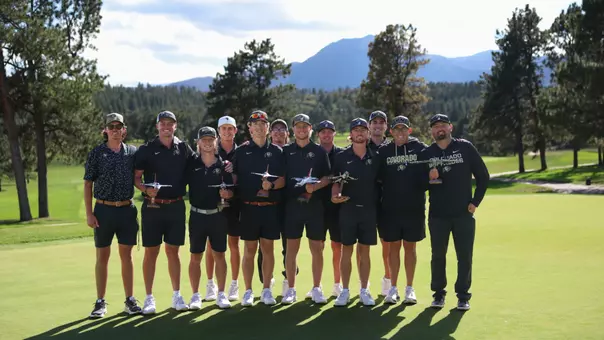
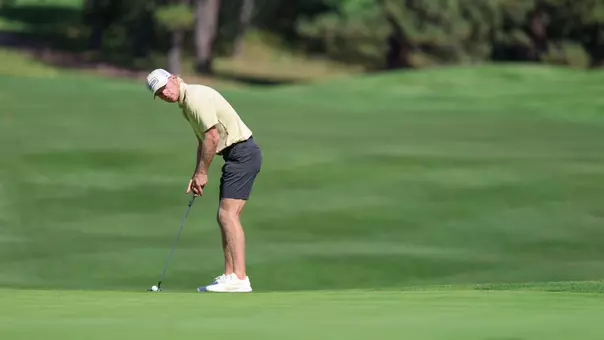
Thursday, March 26
Tuesday, August 12
Tuesday, February 06
Tuesday, February 06