Bye Week Trip Into The Past
October 08, 2026 | General, Alumni C Club
A few shorts on some unforgotten stories
No football game this week, so no flashback to a past history with an opponent. So instead I pulled some sort of same subject stories from my soon-to-be published, "Plati-'Tudes: The Book" that revisit some other historical snippets.
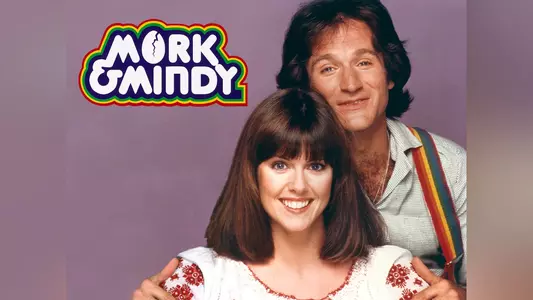
"Mork & Mindy" Call Boulder Home
Mork & Mindy had premiered on ABC on September 14, 1978, and by the end of the ratings year in May, it tied for the third-most popular television show with Happy Days (28.6 rating), behind Laverne & Shirley (30.5) and Three's Company (30.3). The production crew, with the stars, had visited Boulder the previous summer to film some shots they would utilize in and around the show, the most popular being shots of the two main stars, Robin Williams and Pam Dawber, at Folsom Field, walking on the Pearl Street Mall, and at their Boulder home at 1619 Pine Street. They returned in early July '79 to update those (Williams had performed his act in Macky Auditorium in-between in March).
In the original Folsom Field shot, Williams was perched on the south goal crossbar, clinging to the left goal post, with Dawber egging him on from below. The updated shot had Dawber holding on to the right goal post with Williams on the left side. In the closing credits, there was a nice still photo from inside the stadium, showcasing the COLORADO in the south end zone with the Flatirons as the backdrop. Pretty sweet publicity for the school, eh? Especially since the football team was about to embark on some losing times.
Years later, Dawber in an interview said, "Can you imagine nowadays letting anyone do that? No harnesses or anything, it was just kind of like, 'Get up there, don't fall.'" Other scenes were also filmed, including mimicking the infamous Peanuts cartoon where Lucy pulls the ball away at the last second before Charlie Brown could kick it, with Dawber pulling the same stunt on Williams.
Why Boulder? The show's co-creator, Garry Marshall, and Dawber both had some ties to the city. Penny Lee Hallin, Marshall's niece, was a CU student, while Dawber was dating a ski instructor from Boulder at the time and had spent some time here. Remember, Mork was from Ork, they could have selected any ol' town. "The producers said they wanted it to be young and hip," Dawber said. "I said, 'I just came from Boulder, it's a very cool place.' They also just kind of looked at each other, because apparently, Garry had suggested the same thing."
The athletic officials that coordinated the shoots with the production crew were then-ticket manager Jon Burianek and football equipment manager Mike Kerin.
"Williams was in constant motion, and Pam was a lot more calm," Burianek recalled. "They took a few shots of them running around the stadium, doing different things. But Williams in-person was pretty close to what you would see on the show or in his comedy routines."
"I was still pretty new, so they figured to have the young guy be the one to let everyone into the stadium," said Kerin, who lettered three years at tight end for the Buffaloes (1974-76). "We were set for a Sunday shoot, and it was supposed start at 6 a.m. They showed up at 8, if not later. Typical Hollywood, right?" He too said that Williams, "Was the same on camera as he was off it."
"We knew it was going to be great exposure for us," Burianek said. "It ended up being pretty iconic. Everyone wanted to see the house, and everyone wanted to see the stadium."
Gunsmoke's "Doc" – Why the Honorary C?
In 1971, actor Milburn Stone was awarded the "Honorary C," which normally goes to someone who has played some kind of significant role for CU athletics. Stone played Doc Adams for 20 years on Gunsmoke. Yet, he had no obvious tie to the university; he was born and raised in Burton, Kansas; and then spent most of his adult life in California. No one really had recalled that he was awarded the "C" until long after everyone in 1971 who would have known why had passed away.
But the mystery after years of trying to ascertain why was finally solved. In reviewing newspaper archives, it was discovered in the Rocky Mountain News that he was awarded the "C" in a halftime ceremony on November 13, 1971. It was co-honored by Athletics and the University of Colorado Medical Association "for his fine image of the medical profession in his TV role," and by Robert Six, president of Continental Airlines and one of the athletic department's largest donors (who was also married to actress Audrey Meadows, of The Honeymooners fame). Stone attended the game, in which Charlie Davis set the school rushing record of 342 yards (which stands to this day) in a 40-6 romp over Oklahoma State.
ESPN is Coming to Town. Who?
On cable, the Entertainment and Sports Programming Network (ESPN), launched on Friday, September 7, 1979, at 5 p.m. Mountain time with SportsCenter, hosted by George Grande and Lee Leonard. Just 30 minutes at first, a live event followed – a doubleheader in the American Professional Slow Pitch Softball World Series between the Milwaukee Schlitz and the Kentucky Bourbons (seriously).
At the time, live telecasts of college football were limited by the NCAA – maybe around 50-60 annually with one national or a few regional games per week. Until 1984 that is, when the College Football Association (CFA, based right here in Boulder), and the universities of Georgia and Oklahoma won their landmark Supreme Court case freeing up the marketplace for many more broadcasts – and revenue at the time that had all gone to the NCAA coffers.
But some games were approved for tape delay. That's where CU comes in.
The Buffaloes had finished with a 6-5 record in 1978, losing five of their last six games with aspirations dashed – falling out of contention for the Big Eight Conference title and the Orange Bowl berth that it went with. Athletic director Eddie Crowder made the decision to fire head coach Bill Mallory three days after the season. Crowder was intent with making a big splash with the next coaching hire. After a brief flirtation with Nebraska head coach Tom Osborne, Crowder turned his attention to his former rival across the sideline when he was coaching, one-time Oklahoma coach and then current head coach of the New England Patriots, Chuck Fairbanks.
The hiring of Fairbanks turned into a national circus, first with the story of the hiring broken nationally on Monday Night Football by Howard Cosell. The Patriots were a bit peeved to say the least and wound up suing the university. It wouldn't be settled out of court until early April, when CU agreed to pay the Patriots $200,000 (chump change in today's litigious world).
Thus, with the fanfare of Colorado hiring Fairbanks as head coach, the first college football game selected to be televised by ESPN was Oregon at CU on September 8, 1979. Jerry Gross handled the play-by-play duties, and Colorado's own Irv Brown on color commentary (Brown was CU's Buff Club director after retiring as baseball coach after the '78 season). The game kicked off at 1:32 p.m. Mountain time, but was tape delayed later in the day, airing after the third round of the LPGA's Sahara Open and SportsCenter.
Eddie Ford's 6-yard touchdown run and Tom Field's extra point tied the game at 16-16 with 9:44 left in the third quarter before the Ducks would pull away for a 33-19 win, spoiling Fairbanks' debut. Both teams ran 68 plays, but Oregon more than doubled the Buffs in total offense, 453-211.
Buffs On The Big & Little Screens
Bobby Anderson, CU's All-American tailback in 1969, after his playing days and a few acting gigs, surfaced again at the university in 1976 on KOA's radio broadcasts. For the next 29 seasons, he had a major presence on CU broadcasts, mostly as the sideline reporter who also had a pregame show, he was a staple on the broadcasts under five different head coaches. He hosted Chuck Fairbanks' television show all three years (1979-81 on KWGN-TV, Channel 2), and he always traveled on the team plane.
Bobby appeared in several movies. One on One, the basketball-centric movie, was filmed in Fort Collins and featured Colorado State's Moby Gym. Starring Robby Benson and Annette O'Toole, Anderson had a cameo role, playing "Hitman King," the "brutish nemesis" of Benson who you may recall hammered him hard to the floor. He was a sports reporter in American Flyer; was kicking dirt and yelling in the crowd in a Clint Eastwood fight scene in Every Which Way But Loose and was also in Prison for Children. But his craziest role came in the Sleeper, the 1973 Woody Allen film which had scenes filmed at the famous "Space Saucer" house near Mt. Vernon Canyon overlooking Interstate 70. He was part of the security team that wore those red zoot suits that chased Allen through a field before he escaped on a whirly bird mini-helicopter device. He is still officially registered as Bobby C. Anderson on his SAG card, and he secured his roles through a Denver agent, J.F. Images. To this day, he annually continues to receive annual residuals from all, usually in the $1.76 to $5.24 range.
A few others with ties to CU athletics had roles in Hollywood through the years, not counting those on All-America teams that trotted out on Bob Hope Christmas specials.
"Mork & Mindy" Call Boulder Home
Mork & Mindy had premiered on ABC on September 14, 1978, and by the end of the ratings year in May, it tied for the third-most popular television show with Happy Days (28.6 rating), behind Laverne & Shirley (30.5) and Three's Company (30.3). The production crew, with the stars, had visited Boulder the previous summer to film some shots they would utilize in and around the show, the most popular being shots of the two main stars, Robin Williams and Pam Dawber, at Folsom Field, walking on the Pearl Street Mall, and at their Boulder home at 1619 Pine Street. They returned in early July '79 to update those (Williams had performed his act in Macky Auditorium in-between in March).
In the original Folsom Field shot, Williams was perched on the south goal crossbar, clinging to the left goal post, with Dawber egging him on from below. The updated shot had Dawber holding on to the right goal post with Williams on the left side. In the closing credits, there was a nice still photo from inside the stadium, showcasing the COLORADO in the south end zone with the Flatirons as the backdrop. Pretty sweet publicity for the school, eh? Especially since the football team was about to embark on some losing times.
Years later, Dawber in an interview said, "Can you imagine nowadays letting anyone do that? No harnesses or anything, it was just kind of like, 'Get up there, don't fall.'" Other scenes were also filmed, including mimicking the infamous Peanuts cartoon where Lucy pulls the ball away at the last second before Charlie Brown could kick it, with Dawber pulling the same stunt on Williams.
Why Boulder? The show's co-creator, Garry Marshall, and Dawber both had some ties to the city. Penny Lee Hallin, Marshall's niece, was a CU student, while Dawber was dating a ski instructor from Boulder at the time and had spent some time here. Remember, Mork was from Ork, they could have selected any ol' town. "The producers said they wanted it to be young and hip," Dawber said. "I said, 'I just came from Boulder, it's a very cool place.' They also just kind of looked at each other, because apparently, Garry had suggested the same thing."
The athletic officials that coordinated the shoots with the production crew were then-ticket manager Jon Burianek and football equipment manager Mike Kerin.
"Williams was in constant motion, and Pam was a lot more calm," Burianek recalled. "They took a few shots of them running around the stadium, doing different things. But Williams in-person was pretty close to what you would see on the show or in his comedy routines."
"I was still pretty new, so they figured to have the young guy be the one to let everyone into the stadium," said Kerin, who lettered three years at tight end for the Buffaloes (1974-76). "We were set for a Sunday shoot, and it was supposed start at 6 a.m. They showed up at 8, if not later. Typical Hollywood, right?" He too said that Williams, "Was the same on camera as he was off it."
"We knew it was going to be great exposure for us," Burianek said. "It ended up being pretty iconic. Everyone wanted to see the house, and everyone wanted to see the stadium."
Gunsmoke's "Doc" – Why the Honorary C?
In 1971, actor Milburn Stone was awarded the "Honorary C," which normally goes to someone who has played some kind of significant role for CU athletics. Stone played Doc Adams for 20 years on Gunsmoke. Yet, he had no obvious tie to the university; he was born and raised in Burton, Kansas; and then spent most of his adult life in California. No one really had recalled that he was awarded the "C" until long after everyone in 1971 who would have known why had passed away.
But the mystery after years of trying to ascertain why was finally solved. In reviewing newspaper archives, it was discovered in the Rocky Mountain News that he was awarded the "C" in a halftime ceremony on November 13, 1971. It was co-honored by Athletics and the University of Colorado Medical Association "for his fine image of the medical profession in his TV role," and by Robert Six, president of Continental Airlines and one of the athletic department's largest donors (who was also married to actress Audrey Meadows, of The Honeymooners fame). Stone attended the game, in which Charlie Davis set the school rushing record of 342 yards (which stands to this day) in a 40-6 romp over Oklahoma State.
ESPN is Coming to Town. Who?
On cable, the Entertainment and Sports Programming Network (ESPN), launched on Friday, September 7, 1979, at 5 p.m. Mountain time with SportsCenter, hosted by George Grande and Lee Leonard. Just 30 minutes at first, a live event followed – a doubleheader in the American Professional Slow Pitch Softball World Series between the Milwaukee Schlitz and the Kentucky Bourbons (seriously).
At the time, live telecasts of college football were limited by the NCAA – maybe around 50-60 annually with one national or a few regional games per week. Until 1984 that is, when the College Football Association (CFA, based right here in Boulder), and the universities of Georgia and Oklahoma won their landmark Supreme Court case freeing up the marketplace for many more broadcasts – and revenue at the time that had all gone to the NCAA coffers.
But some games were approved for tape delay. That's where CU comes in.
The Buffaloes had finished with a 6-5 record in 1978, losing five of their last six games with aspirations dashed – falling out of contention for the Big Eight Conference title and the Orange Bowl berth that it went with. Athletic director Eddie Crowder made the decision to fire head coach Bill Mallory three days after the season. Crowder was intent with making a big splash with the next coaching hire. After a brief flirtation with Nebraska head coach Tom Osborne, Crowder turned his attention to his former rival across the sideline when he was coaching, one-time Oklahoma coach and then current head coach of the New England Patriots, Chuck Fairbanks.
The hiring of Fairbanks turned into a national circus, first with the story of the hiring broken nationally on Monday Night Football by Howard Cosell. The Patriots were a bit peeved to say the least and wound up suing the university. It wouldn't be settled out of court until early April, when CU agreed to pay the Patriots $200,000 (chump change in today's litigious world).
Thus, with the fanfare of Colorado hiring Fairbanks as head coach, the first college football game selected to be televised by ESPN was Oregon at CU on September 8, 1979. Jerry Gross handled the play-by-play duties, and Colorado's own Irv Brown on color commentary (Brown was CU's Buff Club director after retiring as baseball coach after the '78 season). The game kicked off at 1:32 p.m. Mountain time, but was tape delayed later in the day, airing after the third round of the LPGA's Sahara Open and SportsCenter.
Eddie Ford's 6-yard touchdown run and Tom Field's extra point tied the game at 16-16 with 9:44 left in the third quarter before the Ducks would pull away for a 33-19 win, spoiling Fairbanks' debut. Both teams ran 68 plays, but Oregon more than doubled the Buffs in total offense, 453-211.
Buffs On The Big & Little Screens
Bobby Anderson, CU's All-American tailback in 1969, after his playing days and a few acting gigs, surfaced again at the university in 1976 on KOA's radio broadcasts. For the next 29 seasons, he had a major presence on CU broadcasts, mostly as the sideline reporter who also had a pregame show, he was a staple on the broadcasts under five different head coaches. He hosted Chuck Fairbanks' television show all three years (1979-81 on KWGN-TV, Channel 2), and he always traveled on the team plane.
Bobby appeared in several movies. One on One, the basketball-centric movie, was filmed in Fort Collins and featured Colorado State's Moby Gym. Starring Robby Benson and Annette O'Toole, Anderson had a cameo role, playing "Hitman King," the "brutish nemesis" of Benson who you may recall hammered him hard to the floor. He was a sports reporter in American Flyer; was kicking dirt and yelling in the crowd in a Clint Eastwood fight scene in Every Which Way But Loose and was also in Prison for Children. But his craziest role came in the Sleeper, the 1973 Woody Allen film which had scenes filmed at the famous "Space Saucer" house near Mt. Vernon Canyon overlooking Interstate 70. He was part of the security team that wore those red zoot suits that chased Allen through a field before he escaped on a whirly bird mini-helicopter device. He is still officially registered as Bobby C. Anderson on his SAG card, and he secured his roles through a Denver agent, J.F. Images. To this day, he annually continues to receive annual residuals from all, usually in the $1.76 to $5.24 range.
A few others with ties to CU athletics had roles in Hollywood through the years, not counting those on All-America teams that trotted out on Bob Hope Christmas specials.
- Poncho Hodges (basketball) appeared in a few movies and TV series, most notably True Blood and Law & Order (in the latter, he played a star player who murdered an obnoxious fan);
- Fred Lima (football) had bit parts in The Godfather and Save The Tiger (in The Godfather, he was on screen for maybe all of six seconds as the driver of the car that briefly stopped in front of the hospital where Michael and Enzo the Baker were standing guard with the Don recovering from being shot);
- Eric McCarty (football) played an extra in 1979's Over the Edge, Matt Dillon's first film which was shot in Denver and Aurora; it was about a group of bored teenagers who rebelled against authority;
- Jeff Raymond (football) played the "spokesman" role in St. Pauli beer commercials;
- Ryan Sutter (football) was a contestant on ABC's The Bachelorette. He actually won the heart of Trista, the two got married in 2003, had two children, and remain married to this day.
- Annette Tannander (track & field) In 1980, played Ursula Krull in the movie, Golden Girl, the East German favorite to win the 100-, 200- and 400-meter dashes in the Moscow Olympics (she was "beaten" by the Golden Girl, played by Susan Anton).
- And two athletes appeared on the Tonight Show: Bill Toomey after he won the Olympic decathlon at the 1968 Mexico City games (he actually took Johnny Carson out to Mt. SAC and ran him through the 10 events), and Charles Johnson after he led the Buffs to the win over Notre Dame in the '91 Orange Bowl that clinched the national championship (Jay Leno hosted that show, but Johnny and Ed McMahon were present; they took C.J. out of the studio and Ed snapped a football to him to pass to Carson!).
The university produced a handful of famous actors, most notably Robert Redford, Christopher Meloni (Stabler on Law & Order SVU), Larry Linville (Frank Burns on M*A*S*H) and Joan Van Ark (Val Ewing on Dallas and Knots Landing).
Bye Week Blues
"When it rains, it pours" department: in 1993 Colorado was ranked No. 11 in the Associated Press preseason poll, and after opening 2-0 with convincing wins over Texas and Baylor, rose to No. 7. But then CU dropped two in a row to Stanford on the road and to Miami-Florida at home, both of which featured some horrendous officiating calls. The first by the Pac-10 refs which allowed a touchdown that Dwayne Davis seemingly broke up before the Cardinal tight truly had established possession (take your own look at the 3:05:35 mark https://www.youtube.com/watch?v=KnNxuqHmv9M), and then by the Big East crew, notorious for being the worst in the business (a phantom face mask call on Heath Irwin when CU was driving for the winning score (go to the 3:02:00 mark: https://www.youtube.com/watch?v=4WgGjG17_ww; I don't see it, do you?). Thus, CU fell to 2-2 and down to No. 19 in the rankings prior to its annual bye week.
The following Tuesday after the Miami loss, the ABC sitcom Coach was in its sixth season, and this episode opened with Dauber enthusiastically yelling, "I can't believe we beat the bigger, stronger and faster Colorado Buffaloes, 58-54!" Talk about salt in our wounds…
Did You Know?
I'll close with a couple from my "Did You Know?" series.
In the fall of 1976, the CU coaches show featuring Bill Mallory (cleverly named "CU '76") aired on KBTV (Channel 9) was hosted by none other than Stu Nahan, of Rocky and Fast Times at Ridgemont High movie fame. Most will remember that Robert Six, president of Continental Airlines, was a big donor to the CU program and best friends with athletic director Eddie Crowder. The idea of flying in Nahan weekly to do the show came to be after he had already done Rocky (1976). He did two years of the show, the second of which moved to KOA-TV (Channel 4) and was cleverly renamed "CU 77."
In the 1995 movie, Apollo 13, Kevin Bacon played astronaut Jack Swigert, who lettered three years at linebacker for the Buffaloes in the early 1950's. Swigert, along with James Lovell and Fred Haise, were the three people who made the longest road trip in 1970 at the time in human history (the moon was at its furthest from Earth during all the Apollo missions) until the Artemis space flight earlier this year when the moon was 4,000 miles farther away.
Bye Week Blues
"When it rains, it pours" department: in 1993 Colorado was ranked No. 11 in the Associated Press preseason poll, and after opening 2-0 with convincing wins over Texas and Baylor, rose to No. 7. But then CU dropped two in a row to Stanford on the road and to Miami-Florida at home, both of which featured some horrendous officiating calls. The first by the Pac-10 refs which allowed a touchdown that Dwayne Davis seemingly broke up before the Cardinal tight truly had established possession (take your own look at the 3:05:35 mark https://www.youtube.com/watch?v=KnNxuqHmv9M), and then by the Big East crew, notorious for being the worst in the business (a phantom face mask call on Heath Irwin when CU was driving for the winning score (go to the 3:02:00 mark: https://www.youtube.com/watch?v=4WgGjG17_ww; I don't see it, do you?). Thus, CU fell to 2-2 and down to No. 19 in the rankings prior to its annual bye week.
The following Tuesday after the Miami loss, the ABC sitcom Coach was in its sixth season, and this episode opened with Dauber enthusiastically yelling, "I can't believe we beat the bigger, stronger and faster Colorado Buffaloes, 58-54!" Talk about salt in our wounds…
Did You Know?
I'll close with a couple from my "Did You Know?" series.
In the fall of 1976, the CU coaches show featuring Bill Mallory (cleverly named "CU '76") aired on KBTV (Channel 9) was hosted by none other than Stu Nahan, of Rocky and Fast Times at Ridgemont High movie fame. Most will remember that Robert Six, president of Continental Airlines, was a big donor to the CU program and best friends with athletic director Eddie Crowder. The idea of flying in Nahan weekly to do the show came to be after he had already done Rocky (1976). He did two years of the show, the second of which moved to KOA-TV (Channel 4) and was cleverly renamed "CU 77."
In the 1995 movie, Apollo 13, Kevin Bacon played astronaut Jack Swigert, who lettered three years at linebacker for the Buffaloes in the early 1950's. Swigert, along with James Lovell and Fred Haise, were the three people who made the longest road trip in 1970 at the time in human history (the moon was at its furthest from Earth during all the Apollo missions) until the Artemis space flight earlier this year when the moon was 4,000 miles farther away.

Wednesday, October 07
Wednesday, October 07
Tuesday, October 06
Tuesday, October 06