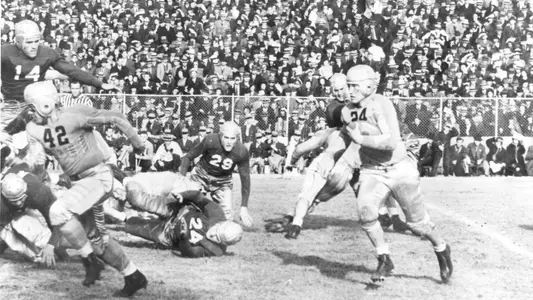
Byron "Whizzer" White accounted for all 34 points in a win over Denver.
Photo by: CUBuffs.com
November 27, 2026 | Football
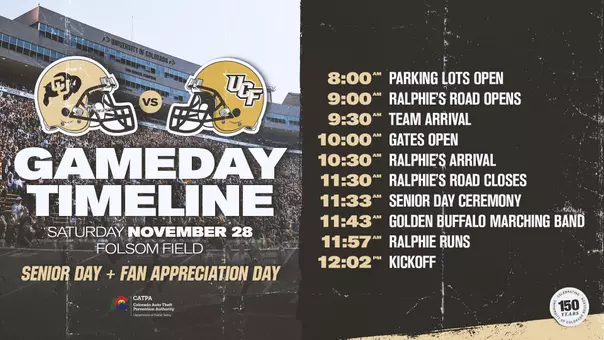
The end of Colorado's 137th regular season in football is upon us Saturday with UCF (a.k.a. the University of Central Florida) in Boulder, the first team from the Eastern Time Zone to visit Folsom Field and serve in such a capacity (regular season; postseason conference championship and bowl games not included, and neither is a 1924 Christmas and New Year's Day visit for two games in Hawai'i, the only times in CU history the Buffs traveled anywhere by boat).
Through the years, the opponents have ranged from Colorado Mines and the University of Denver in CU's pre-Big 7 days, several times on Thanksgiving Day; then a diet of mostly Air Force, Kansas State and Iowa State in the 48 years of Big 7 and Big 8 membership; Nebraska on the Friday after turkey day all 15 times in its first time in the Big 12; and Utah all but once in the 13-year run in the Pac-12.
UCF will be the third different opponent in as many seasons in the Buffaloes' 2024 return to the Big 12 after Oklahoma State and Kansas State.
[Some more trivia: CU only on three occasions has ended its regular season outside of the Mountain and Central Time Zones – in 1915 at Washington, 1952 at Michigan State and 2018 at California.]
Here's a look at some of the most significant regular season finales in school history:
November 26, 1891 (at Colorado Springs) – The ninth game in program history saw the school's first victory, a 24-4 triumph over the Colorado Springs Athletic Association. Up until this game, CU had scored just two touchdowns, both by the defense, but quarterback Pat Carney ran the ball into the end zone for the Silver & Gold's first offensive score (by the way, touchdowns were worth four points at the time). It was CU's first Thanksgiving Day affair.
November 25, 1920 (at Oklahoma City) -- Colorado capped its first season under head coach Myron Witham with its most dominant performance to date outside of the state's borders, crushing Oklahoma A & M (now Oklahoma State), 40-7 on Thanksgiving Day. The win in CU's only non-conference game of the year gave the Silver & Gold a 4-1-2 record.
November 22, 1924 (in Boulder) – Colorado was 4-0-1 and Denver 3-1-2 in Rocky Mountain Athletic Conference play heading into their final games. The Silver & Gold had outscored RMAC opponents 88-0, DU had scored … and allowed … only 16, but the two had battled to a scoreless tie. CU drilled Colorado State (then Colorado A&M), 36-0, as Earl Loser was anything but, scoring two touchdowns – one on an interception return – three field goals and three extra points for scoring 24 of CU's points in a 36-0 win over the Aggies and clinching a second straight RMAC title for CU. Loser's pick was one of seven by the Silver & Gold (CU was still a decade away from the nickname Buffaloes), setting the school record that has been tied once since (against Utah in 1953).
November 25, 1937 (in Denver) – Colorado had cracked the Associated Press national rankings for the first time just two week earlier and entered the annual battle with Denver as the No. 16 team in the land. Byron "Whizzer" White had brought national attention to the program, and he didn't disappoint in this turkey day clash by scoring 22 points – touchdown runs of 51 and 19 yards, an interception return for 46 yards and a score, and four extra point kicks; he also threw two TD passes to Leon Lavington to have a hand in all 34 CU points. White finished the game with season totals of 1,121 rushing yards, 1,596 yards of total offense and 122 points scored, all figures that led the nation with the scoring mark a new record by 19 points. The 34-7 verdict completed an 8-0 regular season, clinched CU's first outright RMAC title since 1924 and would earn the Buffs their bowl berth, as CU was pitted against No. 18 Rice in the Cotton Bowl on New Year's Day.
November 30, 1939 (in Boulder) – CU had turned its season around with four straight wins after dropping the first three games and were 4-1 in the conference. Utah had finished its year a week earlier with a win over Utah State for a 4-1-1 record in Mountain States Conference play. Thus it came down to the annual Thanksgiving Day battle between CU and DU, the first time in Boulder in eight years. The Buffs spotted the Pioneers a 10-0 lead and still trailed, 17-13, in the third quarter. Leo Stasica, who rushed for one touchdown and passed for another, repeated both feats in the fourth quarter and when the smoke cleared, CU had won 27-17 and claimed the MSC title.
November 25, 1942 (in Denver) – A 31-6 win over Denver allowed the Buffaloes to tie Utah for the Mountain States (Big 7) title with a 5-1 league record, but the true significance was with World War II raging, both teams rosters would be depleted with many called up to fight in the war in either the European or Pacific theaters. Maurice "Tex" Reilly threw for 154 yards and a pair of TD passes to Dick Woodward
highlighting the CU offensive attack. A proposal to rematch the Buffs and Utes to decide the outright champ fizzled quickly. Many would return to finish their education and athletic careers after the war, Reilly and Woodward among them, but sadly some also perished. Zeigler was captured by the Germans in their last major offensive (the Battle of the Bulge in January 1945) and was in a POW camp until the war ended four months later; he did not return to CU. War Bond purchases around the CU-DU game ball netted over $140,000.
November 25, 1950 (at Fort Collins) – Colorado was 4-4-1 in its third season under Dal Ward, while Colorado State was 6-2 and had won the last two in the series (after the Buffs had reeled off 12 straight wins). So, the Buffaloes were out to prevent the hat trick by the Aggies and give Ward his first winning season. Behind fullback Merwin Hodel's 129 yards rushing including a TD and two scores by Dane Graves, CU rolled to a 31-6 win, outgaining CSU, 408-189, accomplishing both goals it had for the game.
November 10, 1956 (at Columbia) – The quirky '56 schedule had CU close the regular season with two non-league games at Utah and Arizona. But winning or losing those didn't matter; Oklahoma was on its way to another Big 7 championship but was ineligible for the Orange Bowl because it went the year before (no Big 7 team at the time could go in consecutive years). CU was 4-1 on league play, Missouri was 2-1 and a win would give it the edge over CU if it won its last two games. The game ended in a n improbable 14-14 tie – when the Tigers took a 14-0 lead with under six minutes left in the third quarter, it had run 67 plays to CU's 17 and held the ball for 33 of the game's 38-plus minutes. The Buffs rallied for the tie thanks to a pair of Boyd Dowler to Frank Clarke TD passes, the latter with 10:02 remaining. After swapping punts. Mizzou drove to the Buff 15, where on 4th-&-2, Dick Stapp stuffed the Tigers' Charles James and CU took over and ran out the clock. Had Missouri won its last two league games to join the Buffs in a tie for second at 4-1-1 (behind 6-0 OU, but MU split those), the conference was expected to flip a coin to see who would represent it in the Orange Bowl (where CU defeated Clemson, 27-21).
December 2, 1961 (in Boulder) – The Buffaloes clinched the Big Eight title and Orange Bowl berth that went with it the previous week against Iowa State. Air Force was having a down season and invaded Folsom Field, knowing it had spoiled CU's previous year's finale with a 16-6 win. The Buffs had climbed to their highest ranking of the year – No. 6 – and wanted to hold or improve it before the bowl match-up with No. 4 LSU. The Falcons were intent on leaving Boulder with a second straight upset and led 12-7 in the second quarter. An 11-yard TD pass from Gale Weidner to Jerry Hillebrand, who booted the extra point, 42 seconds before halftime put CU ahead for good in an eventual 29-12 win. It improved CU to 9-1 on the year, matching the '24 team (9-0) for most wins in a season.
December 7, 1963 (at USAFA, Colo.) – The game had been scheduled for November 23, but with President John F. Kennedy assassinated the day before, most of college football went dark. The schools agreed to reschedule the game two weeks later, Air Force needing a win to earn a bowl invitation and CU wanting to play the spoiler – and nearly did. The game was devoid of the usual pageantry in deference to the JFK assassination as well as the 22nd anniversary of Japan's attack on Pearl Harbor. Noble Milton's two touchdown runs of 30 and 3 yards gave CU 7-3 and 14-10 leads, respectively, the last with 13:16 left in the game. But Air Force responded with a 16-play, 80-yard drive that included converting a 4th-and-8 at the CU 23 on its way to score the winning TD for a 17-14 verdict. AFA improved to 7-3 with the win and were invited postgame to the Gator Bowl (where it lost to North Carolina, 35-0). CU, which had been decimated by NCAA penalties, finished 2-8 in Eddie Crowder's first season as CU head coach.
November 20, 1971 (in Boulder) – Colorado stood 8-2 on the season, ranked 10th, but needed a win over Air Force to clinch a bowl invitation to either the Astro-Bluebonnet, Gator or even the Cotton bowls – but a loss could have left CU at home with just 12 bowls at the time and conference mates Nebraska and Oklahoma (Orange and Sugar) guaranteed invites depending on the outcome in the "Game of the Century" five days later on Thanksgiving (NU won, 35-31) and the Sun Bowl looking to invite Iowa State if it beat Oklahoma State (which it did, 54-0). With the CU freshman setting the stage on Friday with a 69-7 trouncing of the AFA yearlings, the varsity followed suit with a 53-17 rout over a revenge-minded Falcon team which had lost out the Sugar Bowl the previous year after CU blasted them, 49-19. Close for a while with CU ahead 7-3 after the first quarter, a 20-point second stanza and another in the fourth paved the way for an eventual invitation to the Astro-Bluebonnet Bowl (where the Buffs beat Houston 29-17 and finish third in the nation, behind those league cohorts, the Huskers and Sooners).
November 20, 1976 (at Manhattan) – No. 15 Colorado simply needed a win over lowly Kansas State on the road to lock up a share of the Big Eight title and earn an invitation to the Orange Bowl by virtue of tiebreakers. But the Wildcats, 1-9 overall and winless in league play, put up a fight on a typical Midwestern windy day, working to a 14-7 lead in the first quarter. A pair of Jim Kelleher touchdown runs vaulted the Buffs ahead, 21-14, early in the second half, though KSU soon tied the game one last time. CU finally got some breathing room after scores from Jeff Knapple and Tony Reed to open the fourth. K-State scored again and was driving with under a minute to go, but an interception by Mike L. Davis clinched the game and the Buffs escaped with a 35-28 win.
November 23, 1985 (in Boulder) – CU's 30-0 whitewashing of Kansas State gave the Buffs a 7-4 record – equaling their win total for the previous three seasons and bowl fever was gripping the team and fan base. The Freedom Bowl had Colorado if it won listed as its second choice to face a Pacific 10 team behind Tennessee, but when the Volunteers waxed Kentucky improving its chances for the SEC title and Sugar Bowl berth, the Buffs became the Freedom's choice as long as Tennessee beat Vanderbilt the following week, which it did, 35-7. CU rushed for 383 yards against the Wildcats, with the players carrying coach Bill McCartney off the field for the first of three times in his 13-year career.
November 22, 1986 (at Manhattan) – The Buffs again needed to defeat Kansas State to secure a bid to what turned out to be the penultimate Bluebonnet Bowl, entering the game with a 5-5 record after an 0-4 start. The game was never really in doubt, once CU lit the scoreboard up with 2:34 left in the first quarter on a 22-yard TD pass from Marc Walters to O.C. Oliver, the Buffs cruised to a 49-3 win. Walters rushed for 88 yards and two touchdowns, and completed all four of his passes for 111 yards and the score, a 415.6 rating, the highest in CU history with at least two attempts.
November 17, 1990 (in Boulder) – CU polished off a second straight 7-0 mark in Big 8 play with a 64-3 thrashing of Kansas State. Eight players scored touchdowns, two made field goals and nose tackle Garry Howe adding a quarterback sack in the end zone for a safety. After begging Bill McCartney several times for a chance to play a little tight end, outside linebackers Alfred Williams and Kanavis McGhee got their wish in the fourth quarter. With Vance Joseph at quarterback, he first threw to McGhee, who had the pass broken up. When it was Williams' turn, Joseph hit him on the west hash for a 17-yard gain. CU had 28 first downs and 634 yards on offense.
November 23, 1991 (at Ames) – CU earned at least a share of a third straight conference title with a 17-14 at Iowa State. Lamont Warren ran for 168 yards and a touchdown, with Darian Hagan's 8-yard TD pass to Sean Brown providing the winning score in the third quarter. But the story of the day were the weather conditions: 17 degrees, winds howling in excess of 20 miles per hour with snowfall, the makings for the standard blizzard. The Buffs and Nebraska had tied earlier in the season and entered the final game with 5-0-1 league marks; CU needed Oklahoma to beat the Huskers in Lincoln to win the title outright, and it was looking good for a while as the Sooners took an early 14-0 lead. But NU scored two fourth quarter touchdowns, the last with 2:57 left and won, 19-14, forcing the tie for the crown.
November 19, 1994 (in Boulder) –The 41-20 win over Iowa State had three significant highlights: eventual Heisman Trophy winner Rashaan Salaam went over the 2,000-yard mark in rushing and quarterback Kordell Stewart became the Big Eight's all-time total offense leader. The game was never in doubt, and with Rashaan entering the game with 1,796 yards, the Folsom Field scoreboard updated his number after every carry. With just under 11 minutes left in the game, and needing just 12 yards to reach 2,000, Salaam took a handoff and went around the right side for a 67-yard touchdown to the delight of all in the stadium (his last carry as a Buff after gaining 259 yards against the Cyclones). Following the game, the bombshell of the day: head coach Bill McCartney announced his retirement.
November 23, 2001 (in Boulder) – No. 14 Colorado's 62-36 win over No. 2 Nebraska sent shock waves throughout the college football world. In scoring the most points ever against a Husker defense at the time, the Buffaloes matched NU's 7-1 record in the Big 12 North Division with the win and earned the right to play Texas the following week in the league title game. Chris Brown rushed for 198 yards and a school record six touchdowns, with Bobby Purify racing for 154 yards and one score as CU built a 35-3 lead early in the second quarter and rolled from there to the victory. Bobby Pesavento threw for 202 yards and a TD, which was hauled in by Daniel Graham for 21 yards, one of his four receptions for 112 yards. Michael Lewis had 11 tackles and an interception to lead the defensive effort. The Huskers came in with an 11-0 record, ranked No. 2 in both polls but were atop the BCS computer standings.
November 26, 2004 (at Lincoln) – The Buffs stumbled to a 1-4 mark in Big 12 games and chances for a third North Division title in four years seemed to be slim and none; CU's lone win was over Iowa State. A 30-21 win at Kansas followed by a thrilling 38-31 triumph over Kansas State improved the league record to 3-4, tied for second with Nebraska. Now you're saying there's a chance (stealing from a famous movie line). Iowa State's win over Kansas State put the Cyclones one game up (4-3) before finishing at Missouri. NU was out of the picture, having lost to ISU, but the Buffs owned the tiebreaker and would win the division if they beat the Huskers (which they did, 26-20) and Iowa State lost the next day to the Tigers (and it did, 17-14 in overtime). Bobby Purify ran for 130 yards and a score with Joel Klatt passing for 222 and a TD (to Blake Mackey, who caught eight passes for 116 yards) as CU's defense limited NU to just 67 yards rushing in forcing five turnovers (four interceptions, two by Thaddeus Washington).
November 23, 2007 (in Boulder) – Colorado needed a win to become bowl-eligible and took a 17-7 lead over the rival Huskers only to fall behind 35-24 at halftime. But an offensive explosion of 41 points after halftime allowed the Buffs to roll to a 65-51 wild victory. The outburst tied the school record for the most points in a second half and prevented Nebraska from qualifying for the postseason for just the second time in four decades. It also marked just the fifth time CU defeated both NU and Oklahoma in the same season.
November 26, 2016 (in Boulder) -- It all came together this Saturday night after Thanksgiving, as a national television audience and a sellout crowd at Folsom Field witnessed the No. 9 Buffaloes win their first division title in 11 seasons (and their first and only in the Pac-12) in defeating No. 21-ranked Utah, 27-22. The win completed CU's "last to first" season as the Buffs finished 8-1 in league play, performing the largest turnaround from one season to the next in Pac-12 history after going 1-8 the year before. Sefo Liufau threw for 270 yards and a touchdown while rushing for another, with Kenneth Olugbode's 10-yard fumble return for a score clinching the win and CU's first appearance in the Pac-12 title game.
Most other times CU knew it was bowl-bound before the final regular season contest.
Colorado Football Coaches Show featuring Coach Prime | Presented by Aflac | November 25
Tuesday, November 24
LIVE: Coach Prime Meets the Media | Colorado Football | November 24
Tuesday, November 24
LIVE: Coach Prime Meets the Media | Colorado Football | November 17
Monday, November 16
Colorado Football Coaches Show featuring Coach Prime | Presented by Aflac | November 18
Monday, November 16