

University of Colorado Athletics
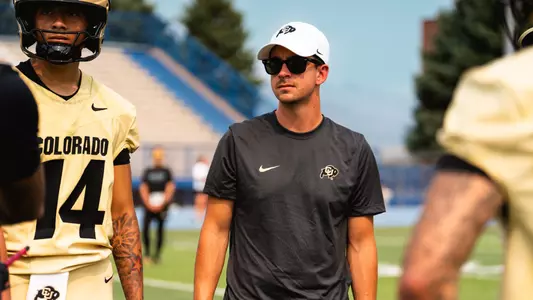
One Step Ahead: AJ Smith Brings A Play-Caller's Journey — And A Virtual Edge — To The Buffs Offense
August 29, 2026 | Football
BOULDER — Before AJ Smith ever fit a virtual reality headset on a quarterback, he was a 21-year-old high school offensive coordinator staring at a playbook he couldn't stand.
"If I went in there with a playbook, man, that thing is not getting open," Smith said. "So that was like the first time I went back and Googled how to create something called a flash game, and I created the first ever, like, Tecmo Bowl playbook."
Two decades later, that instinct — build the tool you wish existed — has followed Smith through college football, the XFL and UFL, and now to Boulder, where he joined the Buffs in January as an offensive analyst.
His path to Colorado runs through nearly every level of the sport. The youngest offensive coordinator in his state as a high school coach, Smith moved into the college ranks as a graduate assistant and worked his way through stops including Northwestern State, UL Lafayette, SMU and UCLA before spring football claimed him.
He reconnected with June Jones at SMU and followed him to the XFL's Houston Roughnecks, where the team started 5-0. He later called plays for Wade Phillips, one of the most decorated defensive minds in NFL history — an education Smith says shaped his entire coaching identity.
"That's a challenge, Wade Phillips every day," Smith said. "He can draw up any defense to stop a run, and I got him to say one 'but,' and it was, you know, the perfect pass. So that's where I became a quarterback coach, and specifically really major in throwing the football."
By last season, calling plays for the St. Louis Battlehawks, Smith had seen just about everything — including a year that cycled four quarterbacks through the huddle.
"We still led the league in passing, because we found a way," Smith said. "Any chance you get to call plays is a learning opportunity... because no quarterback is exactly the same."
After six spring-football seasons with four different teams, the pull back to college finally won.
"There had been opportunities, but they had been wrong fits," Smith said. "This was the first one that was the right fit."
It helped that the fit came with history. Smith has known Deion "Coach Prime" Sanders since 2014, when Smith was a 23-year-old at SMU when Deion Sander Jr., was a player there.
"I wanted the best photo ever at the time, when I was 23: Coach Prime, Ed Reed right next to me," Smith said. "That's two legends. Not too many people have a photo like that."
Coach Prime hasn't forgotten either. At Monday's media availability, he pointed Smith out unprompted — one of the "very intelligent guys up top" on game days — and made the room take note of the analyst's 29-12 record as a professional play-caller.
"They have no idea who you are," Coach Prime told him. "They don't understand how talented you are. They don't understand where all you've been."
What Smith brings, mostly, fits in a laptop and a headset. He created Modern Football, a quarterback analytics platform that looks past the box score — release times, field locations, whether that 80-yard hitch was really the quarterback's doing — and he has spent more than a decade refining the virtual reality training system he first pieced together as an SMU graduate assistant, back when the Oculus Rift was new.
"There are hundreds of teams that use this," Smith said. "A lot of teams have it, but they don't know how to use it, and we do."
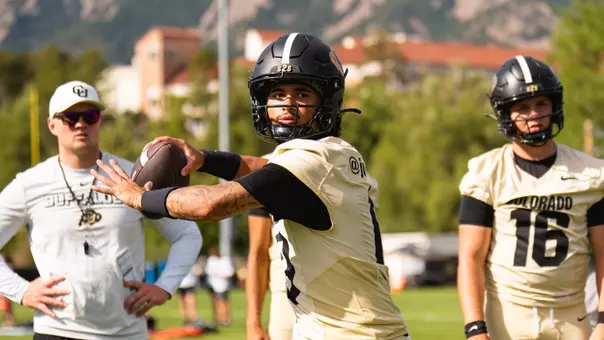
The system's biggest gift goes to the backups: every first-team rep they didn't get at practice, replayed through the starter's eyes. Then Smith turns up the dial.
"We'll say, okay, hey, speed it up to 1.2 — which is flying," Smith said. "Did you go through your progression that fast? They're like, yes. All right, put it back down to one. This is slow. We just made real life slow."
The tools have a willing audience. Smith's UFL quarterback room averaged around 30 years old; Colorado's is under 20, headlined by 18-year-old Julian Lewis. The analyst has been struck by how little the age gap shows.
"To see their work habits and their desire, like, at the pro level — that's been impressive so far," Smith said.
And the numbers say the work is landing. Asked about Lewis' progress since spring, Smith didn't hedge.
"Big strides," Smith said. "That's just through finding differentiators — finding out what's good, what's bad... and then correct them, coach them, drill them. Big, big strides since the spring, and we're going to continue to get better."
From a Flash-game playbook to an 8K headset, the mission hasn't changed in 20 years.
"Just trying to be one step ahead of the game," Smith said.
"If I went in there with a playbook, man, that thing is not getting open," Smith said. "So that was like the first time I went back and Googled how to create something called a flash game, and I created the first ever, like, Tecmo Bowl playbook."
Two decades later, that instinct — build the tool you wish existed — has followed Smith through college football, the XFL and UFL, and now to Boulder, where he joined the Buffs in January as an offensive analyst.
His path to Colorado runs through nearly every level of the sport. The youngest offensive coordinator in his state as a high school coach, Smith moved into the college ranks as a graduate assistant and worked his way through stops including Northwestern State, UL Lafayette, SMU and UCLA before spring football claimed him.
He reconnected with June Jones at SMU and followed him to the XFL's Houston Roughnecks, where the team started 5-0. He later called plays for Wade Phillips, one of the most decorated defensive minds in NFL history — an education Smith says shaped his entire coaching identity.
"That's a challenge, Wade Phillips every day," Smith said. "He can draw up any defense to stop a run, and I got him to say one 'but,' and it was, you know, the perfect pass. So that's where I became a quarterback coach, and specifically really major in throwing the football."
By last season, calling plays for the St. Louis Battlehawks, Smith had seen just about everything — including a year that cycled four quarterbacks through the huddle.
"We still led the league in passing, because we found a way," Smith said. "Any chance you get to call plays is a learning opportunity... because no quarterback is exactly the same."
After six spring-football seasons with four different teams, the pull back to college finally won.
"There had been opportunities, but they had been wrong fits," Smith said. "This was the first one that was the right fit."
It helped that the fit came with history. Smith has known Deion "Coach Prime" Sanders since 2014, when Smith was a 23-year-old at SMU when Deion Sander Jr., was a player there.
"I wanted the best photo ever at the time, when I was 23: Coach Prime, Ed Reed right next to me," Smith said. "That's two legends. Not too many people have a photo like that."
Coach Prime hasn't forgotten either. At Monday's media availability, he pointed Smith out unprompted — one of the "very intelligent guys up top" on game days — and made the room take note of the analyst's 29-12 record as a professional play-caller.
"They have no idea who you are," Coach Prime told him. "They don't understand how talented you are. They don't understand where all you've been."
What Smith brings, mostly, fits in a laptop and a headset. He created Modern Football, a quarterback analytics platform that looks past the box score — release times, field locations, whether that 80-yard hitch was really the quarterback's doing — and he has spent more than a decade refining the virtual reality training system he first pieced together as an SMU graduate assistant, back when the Oculus Rift was new.
"There are hundreds of teams that use this," Smith said. "A lot of teams have it, but they don't know how to use it, and we do."
The system's biggest gift goes to the backups: every first-team rep they didn't get at practice, replayed through the starter's eyes. Then Smith turns up the dial.
"We'll say, okay, hey, speed it up to 1.2 — which is flying," Smith said. "Did you go through your progression that fast? They're like, yes. All right, put it back down to one. This is slow. We just made real life slow."
The tools have a willing audience. Smith's UFL quarterback room averaged around 30 years old; Colorado's is under 20, headlined by 18-year-old Julian Lewis. The analyst has been struck by how little the age gap shows.
"To see their work habits and their desire, like, at the pro level — that's been impressive so far," Smith said.
And the numbers say the work is landing. Asked about Lewis' progress since spring, Smith didn't hedge.
"Big strides," Smith said. "That's just through finding differentiators — finding out what's good, what's bad... and then correct them, coach them, drill them. Big, big strides since the spring, and we're going to continue to get better."
From a Flash-game playbook to an 8K headset, the mission hasn't changed in 20 years.
"Just trying to be one step ahead of the game," Smith said.
Players Mentioned
QB
/ FootballWednesday, August 26
Monday, August 24
Monday, August 24
Monday, August 24